Sellers Outnumber Buyers by a Record 63%: What the Widest Gap Since 2013 Means for Fall Homebuyers
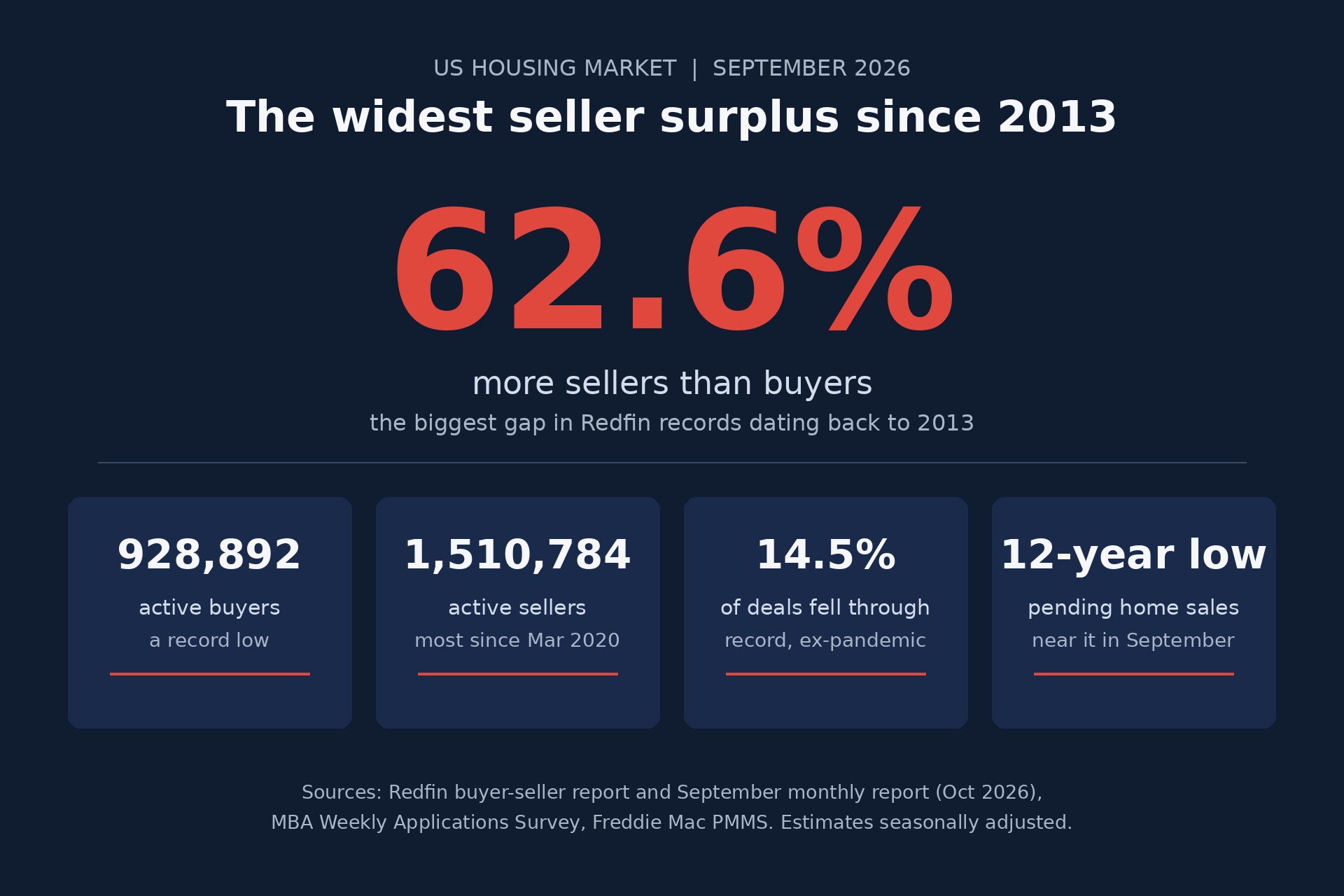
The US housing market just hit an imbalance it has never recorded before. In September, there were an estimated 62.6% more home sellers than buyers, the widest gap in Redfin's records dating back to 2013 and the fourth straight month to set a record. The buyer count fell to the lowest level Redfin has ever measured, while the seller count rose to its highest since March 2020.
The data comes from Redfin's buyer-and-seller analysis, published October 14 and covering September 2026. These are Redfin's estimates of market participants, built from its own tour-to-close data and MLS figures on active listings and pending sales, seasonally adjusted and subject to revision. They are not a census of every buyer and seller, and Redfin warns against reading them as a transaction count.
For context on this week's rate backdrop, see our coverage of Freddie Mac's 7.40% weekly reading and the 7.50% conforming rate print. For the weekly price-cut picture, see Redfin's October asking-price update.
The numbers behind the record
Redfin estimated 928,892 active buyers nationwide in September, down 2.4% from August for a fifth consecutive monthly decline and the lowest total in its dataset. On the other side, it estimated 1,510,784 sellers, up 1.2% from August and the most since March 2020. That is 581,892 more sellers than buyers, or about 163 sellers for every 100 buyers.
The geography is nearly all one color. Forty-one of the 50 most populous metros qualified as buyer's markets in September, the most in Redfin's records. Redfin defines a buyer's market as more than 10% more sellers than buyers. Miami led the nation with 158.9% more sellers than buyers, followed by Nashville at 152.3% and Houston at 134.6%. Just five metros still qualified as seller's markets: Nassau County NY, Montgomery County PA, Newark NJ, Milwaukee, and San Francisco.
Redfin's senior economist Asad Khan summed up the mood: "This is a buyer's market born out of caution, not strength." His point: buyers have negotiating power because so many would-be buyers have been priced out or scared off by economic uncertainty, not because buying has gotten easy.
Demand is collapsing faster than supply is growing
The surplus widened in September because buyers retreated while sellers kept listing. The demand-side numbers are stark across three independent releases.
Pending home sales fell 4% from August to September on a seasonally adjusted basis, Redfin reported October 12, the biggest monthly drop in more than three years and the lowest level since spring 2014, apart from the pandemic freeze in April 2020. For the first time in three years, pending sales declined year over year in all 50 of the largest metros. Seattle fell hardest at 24.4% year over year.
Mortgage applications tell the same story from the financing side. The Mortgage Bankers Association's October 14 survey, covering the week ending October 9, showed the seasonally adjusted purchase index down 4% from the prior week and the unadjusted index down 16% from a year earlier. The average conforming 30-year rate in that survey hit 7.50%, its highest since November 2023, and the adjustable-rate share of applications climbed to 10.5%, the highest in a year, as borrowers hunt for lower initial payments.
Total supply, meanwhile, rose 1.2% from August to its highest level since March 2020. New listings barely moved, up just 0.3%, so the inventory buildup is homes lingering unsold, not a flood of fresh listings.
A record share of deals are falling through
Here is the number that captures the buyer's-market psychology: 14.5% of homebuying deals that went under contract in September were canceled. That is the highest share since the start of the pandemic, and the highest on record other than March and April 2020.
The cancellation hotspots read like a map of the biggest buyer's markets. Jacksonville, FL led the 50 largest metros at 19.9% of deals canceled, followed by Tampa (18.8%), Las Vegas (18.6%), San Antonio (18.5%), and Phoenix (18.4%). San Francisco, one of the last seller's markets, had the lowest share at 2.8%.
Redfin's explanation is straightforward: when buyers have options, they walk away over bad inspections, low appraisals, payments that do not pencil out, or simply a change of heart. In a seller's market, the same buyers would have pushed through.
Sellers are adjusting. One in five sellers with active listings, 19.8%, cut their asking price in September, and the share rose in 43 of the 50 largest metros. Three in five homes that sold, 60.5%, went for less than their original asking price, an 18-month streak. The median sale price still rose 1.3% year over year to $393,895, but that was the smallest increase since February. Prices are losing momentum, not falling nationally, a distinction worth keeping.
The workaround buyers are researching: assumable mortgages
With the 30-year fixed at 7.40% in Freddie Mac's latest weekly survey, buyers are hunting for ways around today's rates, and the search data shows it. RisingTrends reports that searches for "assumable mortgage" ran at 22,200 a month, up 50% year over year, in its October 2026 trend list. Related value-hunting searches are climbing too: "gov auctions" at 110,000 monthly searches, up 122% year over year, and "property tax" at 110,000, up 49%. Those are RisingTrends' own reported figures, not independently verified, so treat them as a signal of interest rather than a precise measurement.
An assumable mortgage lets a buyer take over the seller's existing loan, keeping the original interest rate, remaining balance, and repayment schedule, instead of originating a new loan at today's rates. It only works on certain loan types, and the mechanics differ by program.
VA loans are the clearest case. The VA's own Home Loan Guaranty Buyer's Guide states that anyone can assume a VA home loan if they qualify, veteran or not. The funding fee on an assumption is 0.5%. A veteran buyer can substitute their own VA entitlement for the seller's, restoring the seller's entitlement; if a non-veteran assumes, the seller's entitlement stays tied to that loan. The servicer must approve the transfer and runs an income and credit check.
FHA-insured mortgages are also assumable under federal rules. HUD's regulation, 24 CFR 203.512, establishes a policy of free assumability: lenders may not restrict assumption of an FHA-insured mortgage beyond what the rules specifically permit, and where the loan documents require approval, the buyer must pass a creditworthiness review.
Three caveats from the primary sources, and they matter. First, the equity gap: as the VA guide notes, any equity in the home stays with the loan, so the buyer must cover the difference between the price and the remaining balance in cash or separate financing. Second, conventional loans are generally not assumable, so this only helps where the seller already has government-backed financing. Third, sellers should get a formal release of liability; the VA guide warns that a default on an assumed loan counts against the original veteran's entitlement.
What this means for fall buyers and sellers
For buyers who can still transact, this is the most leverage the market has offered in over a decade: record seller surplus, record cancellation rates, one in five sellers cutting prices, and three in five sales closing below original ask. That is real negotiating room on price, closing costs, repairs, and rate buydowns. Redfin's head of economic research Chen Zhao puts it plainly: when rates climb above 7%, fewer people buy because fewer can afford to, but less competition means more room to negotiate.
For sellers, the message from the data is to price realistically from the start. Homes are lingering, buyers are walking away from contracts at record rates, and Redfin Premier agent Brian Connelly in Boston advises listing potentially 5 to 10% below instinct and prepping meticulously to avoid the negative perception of accruing days on market.
The honest caveat, and it is a big one: leverage does not equal affordability. The surplus exists precisely because borrowing costs have pushed buyers out. A buyer's market born of caution rewards the buyers who remain, but it does not make the math work for those who were priced out. Nothing here is financial advice.
Frequently Asked Questions
How many more sellers than buyers are there right now?
Redfin estimated 62.6% more sellers than buyers in September 2026, about 1,510,784 sellers versus 928,892 buyers. That is the widest gap in Redfin's records dating back to 2013 and the fourth consecutive monthly record.
Is it really a buyer's market everywhere?
Not everywhere, but close. Forty-one of the 50 most populous metros qualified as buyer's markets in September, the most in Redfin's records. The biggest surpluses are in the Sun Belt, led by Miami at 158.9% more sellers than buyers. Five metros are still seller's markets, including San Francisco and suburbs of New York City.
What share of home deals are falling through?
Nationwide, 14.5% of deals that went under contract in September were canceled, the highest share since the start of the pandemic and the highest on record apart from March and April 2020. Jacksonville, FL had the highest metro cancellation rate at 19.9%.
Are sellers cutting prices?
One in five sellers with active listings, 19.8%, cut their asking price in September, and 60.5% of homes that sold went for less than their original asking price. Redfin's separate weekly update found a record 22% of sellers cutting prices in the four weeks ending October 11, covered in our asking-price update.
What is an assumable mortgage, and who can use one?
An assumable mortgage lets a buyer take over the seller's existing loan at its original rate and terms. VA loans can be assumed by anyone who qualifies, veteran or not, with a 0.5% funding fee and servicer approval. FHA-insured mortgages are also assumable under HUD rules, with a creditworthiness review. The buyer must cover the equity gap between the price and the loan balance, and conventional loans generally cannot be assumed.
Is search interest in assumable mortgages really rising?
RisingTrends reports "assumable mortgage" searches at 22,200 a month, up 50% year over year in its October 2026 list. That is the trend-data company's own reported figure, not an independently verified measurement, so read it as a signal of buyer interest rather than a precise count.
Does this mean home prices will fall?
Neither Redfin release predicts future prices. The September data shows prices losing momentum: the median sale price rose just 1.3% year over year to $393,895, the smallest increase since February, while asking prices fell 0.5% month over month. Whether declines repeat is what the next releases will show.
This article summarizes Redfin's buyer-and-seller analysis published October 14, 2026 (September data) and its September monthly housing report published October 12, 2026, plus the MBA Weekly Applications Survey of October 14 and Freddie Mac's Primary Mortgage Market Survey of October 15. Estimates are subject to revision. Nothing here is financial advice.