US Mortgage Rates Reach 7.5% After Hot September Inflation: What Changed

Two days after we reported the 30-year mortgage rate had hit 7.40%, its highest since November 2023, a hotter-than-expected September inflation report sent the market one step further. The September Consumer Price Index, released October 14, showed inflation running hotter than it had a month earlier, and bond traders repriced the odds of a Federal Reserve rate hike at the October 27-28 meeting sharply upward. The Mortgage Bankers Association's weekly survey now puts the average contract rate on a 30-year fixed mortgage at 7.50%, up from 7.49% the prior week, its highest reading since November 2023. The daily survey from Mortgage News Daily had the rate at 7.45% on October 14, down slightly on the day after a morning spike.
The quick version: inflation came in hot, expectations of another Fed hike roughly doubled, and mortgage rates edged up to their highest levels in nearly three years. The MBA's chief economist now expects the 30-year rate to average 7.3% in the fourth quarter and stay above 7% through 2027.
What the CPI report showed
September's headline inflation came in at 3.7% year over year, up from 3.4% in August, according to the Bureau of Labor Statistics release published October 14. On a month-over-month, seasonally adjusted basis, prices rose 0.6%, up from 0.4% in August. Core CPI, which strips out food and energy, rose 2.6% year over year, up from 2.4% in August, with the monthly pace holding at 0.3%.
Gasoline did most of the damage. The gasoline index rose 9.1% for the month and accounted for over half of the entire monthly increase in the all-items index. The energy index rose 5.2% for the month, following a 2.1% rise in August, and is up 20.4% over the past year; gasoline is up 34.2% year over year. Shelter rose 0.4% in September after rising 0.3% in August. The food index was unchanged for the month, with food at home down 0.1% and food away from home up 0.2%.
None of that is what the Federal Reserve wanted to see. Inflation is moving away from the Fed's target, not toward it, and that is exactly the setup that makes another rate hike more likely.
Where mortgage rates stand now
There are three main surveys, and each captures a different slice of the market. They all point the same direction.
The Mortgage Bankers Association's weekly survey for the week ending October 9 put the average contract rate for a 30-year fixed mortgage with a conforming loan balance at 7.50%, up from 7.49% the prior week, the highest since November 2023. MBA vice president and deputy chief economist Joel Kan said: "Mortgage applications decreased as rates moved higher last week. The 30-year fixed rate was 7.5 percent, the highest rate since November 2023 and more than a percentage point higher than a year ago." Jumbo 30-year rates rose to 7.49% from 7.39%. Demand is fading fast: total applications fell 2.7% on a seasonally adjusted basis, the purchase index fell 4% and sits 16% below a year ago, and the refinance index fell 0.4% and is 56% below a year ago. The ARM share of applications rose to 10.5%, its highest since October 2025, as more borrowers trade rate certainty for a lower initial payment.
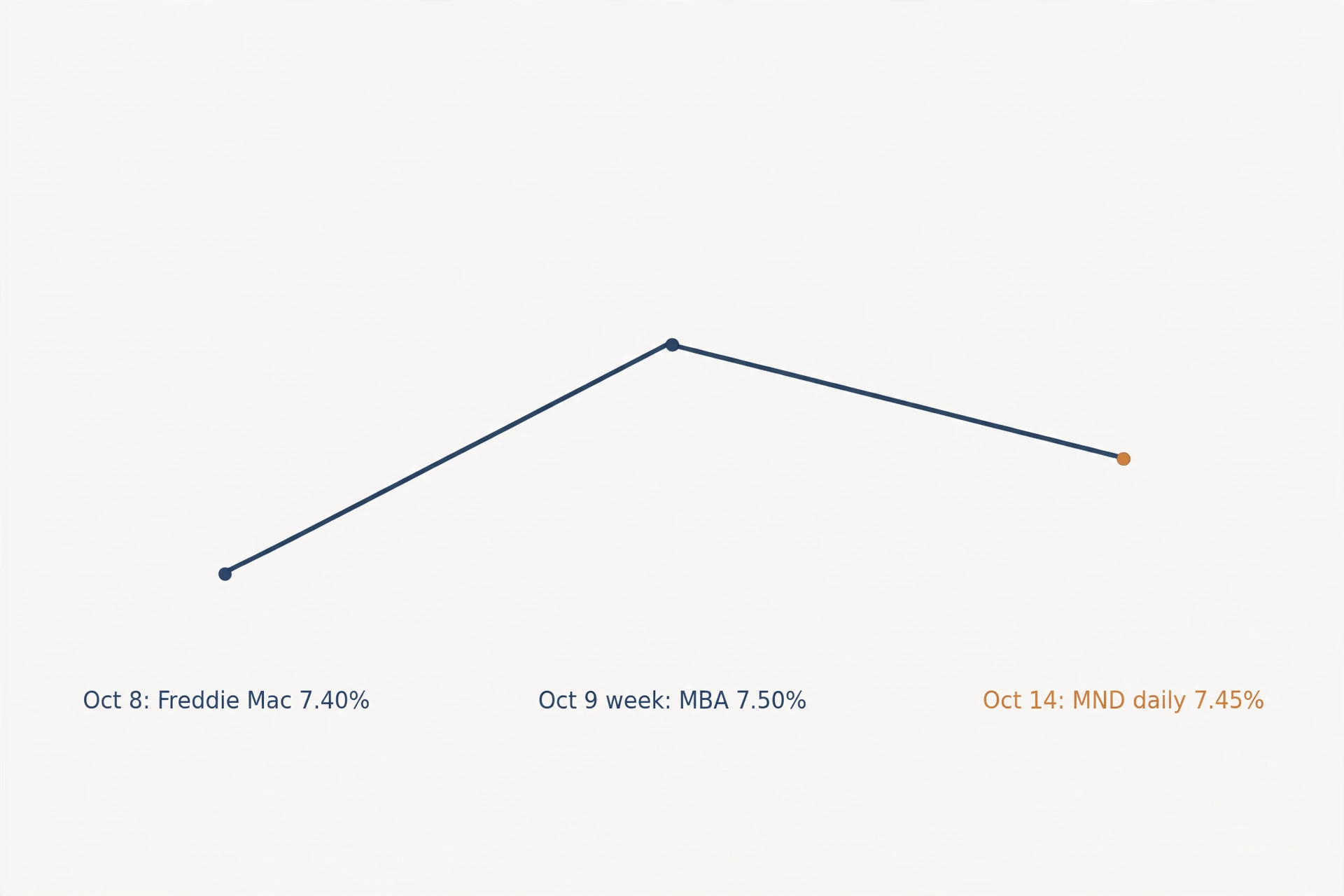
Freddie Mac's weekly survey, for the week ending October 8, reported the 30-year fixed-rate mortgage averaged 7.40%, up from 7.28% the prior week, with the 15-year fixed at 6.73%, up from 6.60%. Those were the numbers in our October 12 coverage. Note that Freddie Mac had not published a reading for the week ending October 15 at the time of writing, so the October 8 figures remain the latest available from that survey.
The daily rate from Mortgage News Daily, which captures day-to-day moves the weekly surveys smooth out, stood at 7.45% on October 14, down 0.01 on the day. Its market update that afternoon described an "epic round trip," with rates launching higher in the morning after the hot CPI print, then ending the day slightly lower. The daily number moves constantly; the weekly surveys are the steadier reference point.
Why a hot CPI report moves mortgage rates
This confuses a lot of buyers, so it is worth stating plainly: the Fed's policy rate does not set mortgage rates. Mortgage rates track bond yields, and bond yields move on what investors expect the Fed to do next. As Mortgage News Daily put it, while the Fed Funds Rate itself does not control mortgage rates, Fed rate expectations tend to correlate much better.
A hot inflation report raises the odds that the Fed keeps raising its policy rate, which pushes bond yields higher, which pushes mortgage rates higher. The 10-year Treasury yield, the closest benchmark, touched 5.36% on October 7, its highest since 2002, as we reported on October 12.
MBA chief economist Mike Fratantoni described the bigger picture in the forecast release: "Mortgage rates have recently spiked to their highest level in more than three years, while 10-year Treasury rates have reached their highest levels in 24 years. Around the world, there are too many borrowers and not enough savers. Inflation is too high, leading central banks to raise short-term rates, while budget deficits and debt are unsustainably high, leading bond investors to push up longer-term rates."
What the Fed's October 28 meeting means for rates
The next Federal Open Market Committee meeting runs October 27-28, with the policy statement released at 2:00 p.m. ET on Wednesday, October 28 and the Chair's press conference at 2:30 p.m. ET the same day.
Market-implied odds of a 25-basis-point hike at that meeting roughly doubled after the CPI print. Dated observations of the CME FedWatch tool, which derives probabilities from 30-day Fed funds futures prices, showed about a 22% chance of an October hike before the release and roughly 47-49% after it. Those readings come from dated press snapshots and move intraday, so treat them as a measure of the shift, not a live number.
The MBA's updated Mortgage Finance Forecast, presented October 11 by Fratantoni, expects two additional 25-basis-point hikes beyond October, one in December 2026 and one in the first quarter of 2027. The same forecast expects the 30-year mortgage rate to average 7.3% in the fourth quarter of 2026 and remain above 7% through 2027, with the 10-year Treasury averaging 5.1% in the fourth quarter and staying close to 5% through 2027.
If you read our coverage of the 7.4% milestone on October 12, the follow-up is simple: the story has not reversed, it has intensified. Rates are higher, the Fed is more likely to hike again, and forecasters now expect the 7% era to last well into 2027.
What to do about your rate lock
The payment math is getting painful. On a $400,000 30-year loan, monthly principal and interest at 7.50% runs about $2,797, versus about $2,398 at 6%, a difference of roughly $399 a month or about $4,784 a year for the identical house. Even the latest tick up from 7.40% (about $2,770 a month) added roughly $27 a month. Those figures are approximate and exclude taxes, insurance, and fees.
For buyers already under contract, the decision is whether to lock a rate now or float and hope for better. A few practical points, none of them financial advice:
Locking protects you if rates keep rising, which is the direction they have moved for weeks. MBA's forecast has the 30-year averaging 7.3% in the fourth quarter, so a lock near today's levels roughly matches what forecasters expect, with the risk that further Fed hikes push it higher. Make sure your lock window comfortably covers your closing date; extending a lock costs money.
Floating is a bet that rates dip before closing. Daily rates do wobble, as the October 14 round trip showed, but floating into a Fed decision week is a gamble that the data goes your way. The CPI surprise went the wrong way for floaters last week.
If you are not yet under contract, the calculus is different. Buyers who can still transact hold more negotiating power, even as financing costs keep climbing. That dynamic also makes renting worth a serious look in many markets: our October 12 analysis found renting cheaper than owning in all 20 of the largest US cities this year. Whatever you choose, get quotes from multiple lenders, which matters most when every basis point costs real money.

Frequently Asked Questions
What is the current 30-year mortgage rate?
The MBA's weekly survey for the week ending October 9 put the average contract rate at 7.50%, the highest since November 2023. Freddie Mac's weekly survey for the week ending October 8 reported 7.40%. The daily rate from Mortgage News Daily stood at 7.45% on October 14.
Why did hot inflation push rates up?
Inflation came in hotter than expected in September, at 3.7% year over year, which raised the odds that the Federal Reserve hikes its policy rate again. Mortgage rates track bond yields, and bond yields move on Fed expectations, not the Fed's policy rate itself. Higher expected Fed rates mean higher Treasury yields, which mean higher mortgage rates.
What are the odds of a Fed hike on October 28?
Dated observations of the CME FedWatch tool showed market-implied odds of a 25-basis-point hike at the October 27-28 meeting rising from about 22% before the CPI release to roughly 47-49% after it. Those readings move intraday, so they describe the shift in expectations rather than a fixed probability.
Will rates go down by the end of 2026?
The MBA's October 11 forecast says no meaningful relief: it expects the 30-year rate to average 7.3% in the fourth quarter of 2026 and stay above 7% through 2027, with two more 25-basis-point Fed hikes expected in December 2026 and early 2027.
Should I lock my rate now?
That depends on your timeline and risk tolerance, and this is not financial advice. If you are under contract with a closing date approaching, locking removes the risk of rates rising further into the Fed's October 28 decision. Make sure the lock covers your full closing window. If you are still shopping, compare lenders and weigh today's financing costs against the negotiating leverage buyers currently hold.
This article summarizes published mortgage-rate data as of October 2026. Rates move daily; nothing here is financial advice.