16 Years to Save a House Deposit: New Report Says Homeownership Is Further Out of Reach

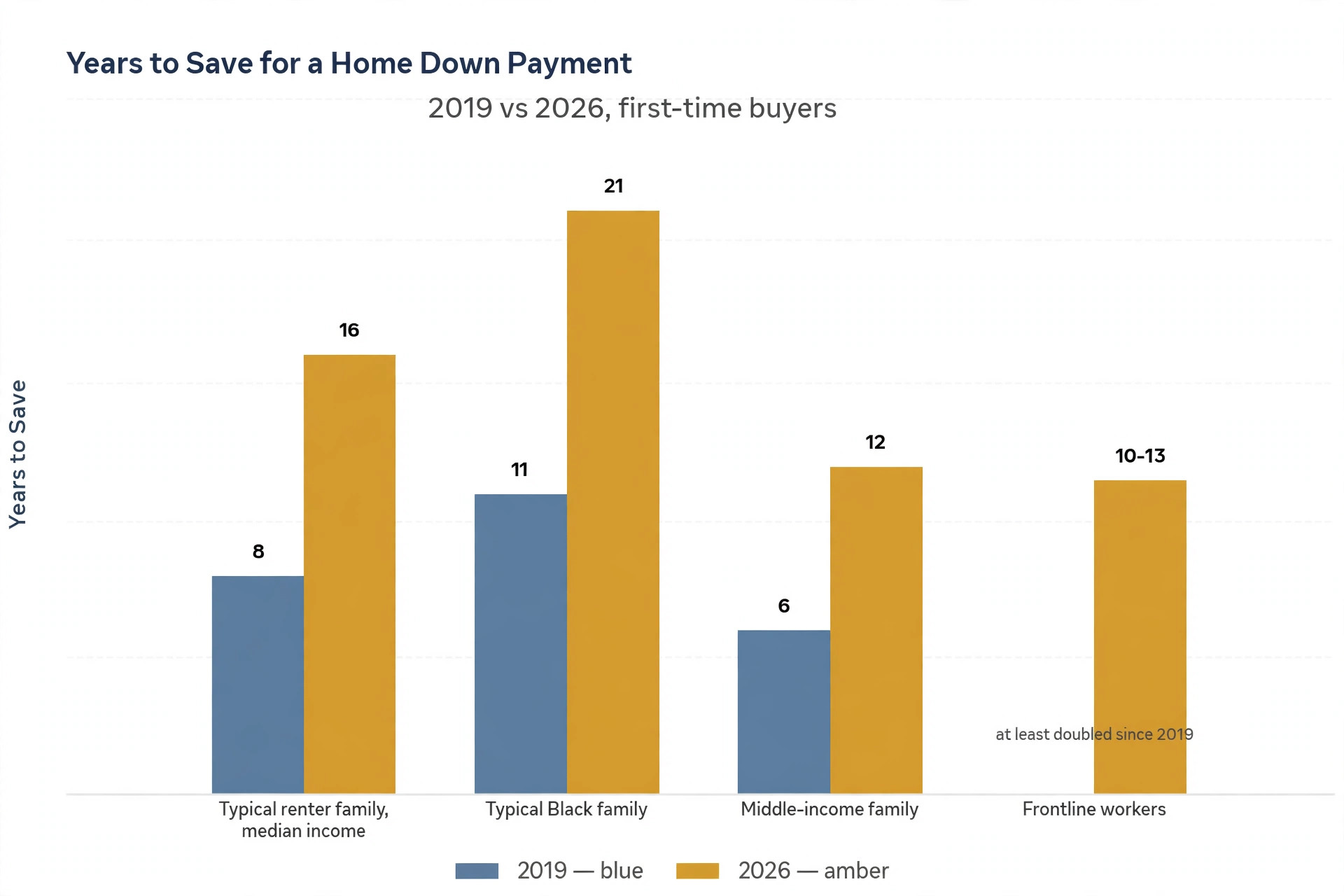
A typical family of renters now needs 16 years to save enough for a down payment and closing costs on a starter home. That is double the time it took in 2019.
The headline figure comes from a new report, "Homeownership Further Out of Reach: The Number of Years First-Time Homebuyers Need to Save for Down Payment and Closing Costs Has Doubled Since 2019," released on Thursday 2026-10-22 by the Julian Bond Institute (JBI) at the Center for Responsible Lending (CRL). The report updates CRL research first published in 2019.
The 16-year figure assumes a family earning the median income among renters, around $58,000, saving at today's national savings rate.
"Families saving for homeownership have a far steeper climb than just a few years ago. Aspiring homeowners are living the harsh reality of the affordability crisis, especially if they can't get money for upfront costs from the 'bank of mom and dad,'" said Mike Calhoun, president of CRL and report co-author. The report was authored by CRL Senior Researcher Dr. Liz Laderman, CRL Senior Fellow David Silberman, and Calhoun.
The climb is steeper for everyone, but not equally
The doubling of the savings timeline applies across income groups, and the burden falls hardest on those already furthest from ownership.
A middle-income family now needs 12 years to save, double what was needed in 2019.
The typical Black family seeking homeownership now needs 21 years to save enough to cover the upfront costs, an increase of 10 years since 2019. That is a rise from 11 to 21 years. According to the JBI publications page, the Black-White disparity between 2019 and 2026 has doubled.
Frontline workers face long timelines too. For firefighters, police, teachers and paramedics, the time needed has at least doubled since 2019 and now ranges from 10 to 13 years.
Big cities are hardest, but rural buyers feel it too
Geography adds another layer to the picture. In the 10 most populous metropolitan areas, a family would need at least 11 years to save, a sharp increase since 2019. In order from most to fewest years, those metros are Los Angeles, New York City, Miami, DC, Chicago, Philadelphia, Phoenix, Atlanta, Dallas, and Houston.
The pressure is not confined to expensive cities. The report finds that the growth in housing prices has outpaced household wages in rural areas at least as much as in urban areas.
The strain shows up in polling too. An ABC Audio item published 2026-10-20 reported that the latest ABC News-Washington Post-Ipsos poll found half of adults say their mortgage or rent is unaffordable. That is a poll result, a snapshot of sentiment, rather than a hard statistic.

The report's prescription: help with the down payment
The report argues that supply alone will not close the gap. Its recommendation, stated in its own words: "Alongside measures to expand the supply of starter homes and other housing, there is an urgent need for policymakers to expand down payment assistance programs for aspiring first-time homebuyers, especially first-generation home buyers."
The JBI publications page adds: "There is a critical need for down payment assistance, low down payment mortgages, and additional housing supply."
Other countries are leaning on the same lever. A joint media release from Australia's Prime Minister and Housing Minister on 1 October 2026, citing Housing Australia data, stated: "One in two first home buyers nationally are now using a first home buyer scheme to get into the market." (See our comparison of Australia's help-to-buy options, including the expanded 5% Deposit Scheme, for more details.)
What this means for would-be buyers
If you are saving for a first home, the report's central message is that the math of 2019 no longer applies. Waiting another year on the same plan will not close a gap that has doubled.
The report points squarely at down payment assistance as the policy lever that matters most for buyers without family wealth. Many states and cities run first-time buyer assistance programs, and the report's argument is that policymakers should expand them, especially for first-generation buyers. If you are buying in the next few years, researching what assistance exists in your area is worth your time.
Meanwhile, the rent-versus-buy arithmetic has shifted in renters' favor for now. Our 2026 rent vs buy analysis found that renting is cheaper than buying in every major US city, and landlords are offering concessions again. That does not make saving easy, but it means the monthly comparison does not punish waiting the way it used to.
Keep an eye on the full cost picture too. The record cost of homeownership, from property taxes to insurance to maintenance, keeps rising even where prices have cooled. Saving the down payment is only the first hurdle.
A note on methodology
The JBI report, which updates CRL research released in 2019, examines how long it would take a typical family saving at today's national savings rate to accumulate enough money to cover a down payment and closing costs for a starter home. The analysis compares years to save across 2019 and 2026 by income, race, occupation and metro area. Granular assumptions (the starter-home price benchmark, the exact savings rate, and the down payment percentage) are not stated in the official release.
Frequently Asked Questions
How long does it take to save for a house deposit?
For a family earning the median income among renters, around $58,000, it now takes 16 years of saving at the national savings rate to cover a down payment and closing costs on a starter home, double the 8 years needed in 2019, according to the October 2026 JBI/CRL report.
Who needs the longest to save?
The typical Black family seeking homeownership now needs 21 years to save enough for the upfront costs, up 10 years since 2019 (from 11 to 21 years). The JBI publications page states that the Black-White disparity between 2019 and 2026 has doubled.
How long do middle-income families need to save?
A middle-income family now needs 12 years to save, double what was needed in 2019.
What about firefighters, police, teachers and paramedics?
For these frontline workers, the time needed has at least doubled since 2019 and now ranges from 10 to 13 years.
Which cities are hardest for first-time buyers?
In the 10 most populous metro areas, a family needs at least 11 years to save. From most to fewest years, the order is Los Angeles, New York City, Miami, DC, Chicago, Philadelphia, Phoenix, Atlanta, Dallas, and Houston.
What does the report recommend?
The report calls for expanding down payment assistance programs for aspiring first-time homebuyers, especially first-generation home buyers, alongside measures to expand the supply of starter homes.
Does the affordability squeeze affect rural buyers too?
Yes. The report finds that housing price growth has outpaced household wages in rural areas at least as much as in urban areas.