How Often Should You Change Your HVAC Filter? (+ Size Chart)
Changing your HVAC filter is the cheapest maintenance task in your house, and skipping it is one of the most expensive mistakes. A clogged filter chokes airflow, raises energy bills by 5 to 15 percent, and can kill a blower motor or freeze an evaporator coil. A $10 filter protects a $5,000 to $10,000 system. Here is how often to change yours, how to find your size, and which filter to buy.
The Short Answer: Change Intervals by Filter Type
Not all filters are built the same, and thickness matters more than brand.
- Standard 1 inch fiberglass or pleated filters: Every 1 to 3 months. These are the thin filters most homes use. They catch larger dust and lint but load up fast.
- 1 inch high MERV pleated filters: Every 2 to 3 months. Denser pleats trap smaller particles, which means they clog a bit faster than basic filters.
- 2 inch pleated filters: Every 3 to 6 months. The extra depth gives more surface area, so they last longer.
- 4 to 5 inch media filters: Every 6 to 12 months. These thick filters, often in a dedicated filter cabinet, hold far more dust and are the longest lasting common type.
- Washable reusable filters: Clean every 1 to 2 months. Rinse with a hose, let them dry completely, and reinstall. They save money over time but need regular attention and never filter quite as well as disposables.
Household Factors That Shorten the Interval
The numbers above assume an average home. Adjust for your situation:
- Pets: With pets, check 1 inch filters monthly and change as needed. Pet hair and dander clog filters faster than anything else.
- Allergies or asthma: Use a MERV 11 to 13 pleated filter and change it on the shorter end of the interval.
- Smokers in the home: Change monthly; smoke residue loads filters fast.
- Construction dust: Change monthly during renovations and once more after. Drywall dust is fine enough to coat the evaporator coil.
- Vacation homes: Every 6 months is fine, but check on arrival since humidity can mold a filter that sat all summer.
- Large households: More people means more dust. Use the shorter end of every interval.
How to Find Your Filter Size
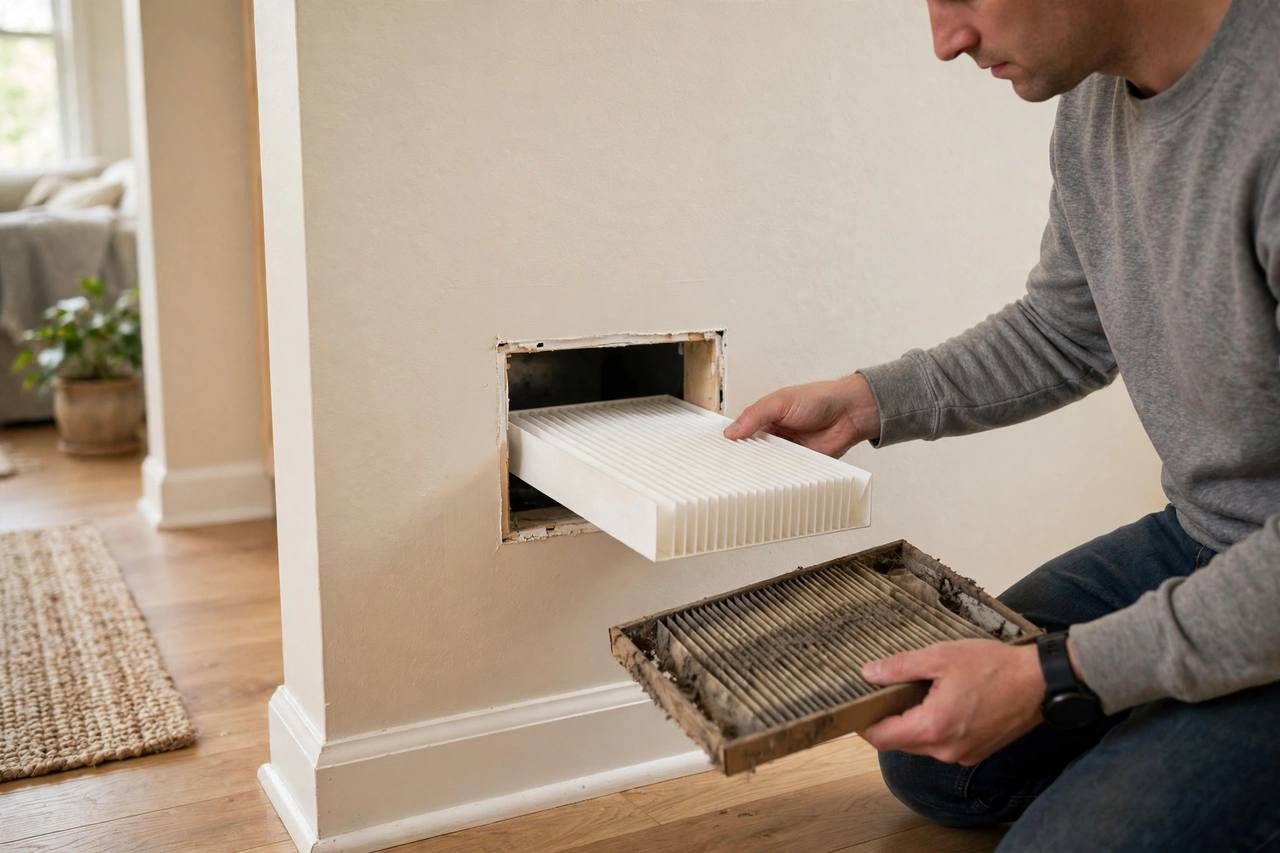
Your filter size is printed on the cardboard frame of the filter currently installed. Slide it out and read the numbers. Sizes are listed as length x width x depth in inches, for example 16x20x1.
Two things to know about sizing:
- Nominal vs actual size: The printed size is nominal; the actual filter measures about half an inch smaller. Buy by the nominal size printed on the old filter.
- Where the filter lives: Usually in a slot at the furnace, in a wall or ceiling return grille, or in a filter cabinet. Check the return grille first; it is the most common spot.
Common Filter Size Chart
These are the sizes you will find at any hardware store or online. If your size is not listed, measure the old filter and order by the nominal dimensions printed on its frame.
| Nominal size | Typical use | Typical change interval | |---|---|---| | 12x12x1 | Small wall returns, window units | 1 to 3 months | | 14x20x1 | Apartments, small homes | 1 to 3 months | | 14x25x1 | Apartments, condos | 1 to 3 months | | 16x20x1 | Very common residential size | 1 to 3 months | | 16x25x1 | Common in single family homes | 1 to 3 months | | 20x20x1 | Larger returns, older homes | 1 to 3 months | | 20x25x1 | One of the most common sizes overall | 1 to 3 months | | 20x25x4 | Media filter cabinets | 6 to 12 months | | 20x30x1 | Larger systems, some commercial | 1 to 3 months | | 25x25x1 | Large homes, high airflow systems | 1 to 3 months |
Odd sizes like 18x30x1 or 24x24x1 exist too. When in doubt, buy the size printed on the old filter, not the size you measure with a tape, since the printed number is the nominal size retailers use.
Which Filter Rating Should You Buy?
Filters carry a MERV rating, which measures how small the particles they catch are. Higher is not automatically better for your system.
- MERV 1 to 4 (basic fiberglass): Catches large dust only. Cheap ($2 to $5) but weak for air quality.
- MERV 5 to 8 (basic pleated): The sweet spot for most homes. Catches dust, pollen, and mold spores ($5 to $12). Safe for virtually all systems.
- MERV 9 to 12 (better pleated): Catches pet dander and fine dust ($10 to $20). Good for allergies.
- MERV 13 to 16 (high efficiency): Costs $15 to $30. Only use if your system is rated for the airflow restriction; check your furnace manual first.
The rule of thumb: MERV 8 pleated suits most homes. Go higher for allergies only if your system handles the restriction. Never stack two filters, and install with the arrow pointing toward the furnace.
What a Dirty Filter Actually Costs You
A moderately clogged filter wastes $10 to $30 a month on a $200 energy bill. Severe restriction can overheat a furnace heat exchanger ($1,000 to $2,500) or freeze an evaporator coil ($600 to $2,000). A year of filters costs $20 to $80. It is not a close call.
A Simple Routine That Actually Works
The reason people forget filters is that the interval is long enough to slip your mind and short enough to matter. Pick one of these and stick with it:
- Phone reminder: Set a monthly reminder to check the filter. Checking monthly and changing as needed beats any fixed schedule.
- The light test: Hold the used filter up to a light. If you cannot see light through it, change it regardless of the schedule.
- Buy in bulk: A 6 or 12 pack costs 20 to 40 percent less per filter, and having spares removes the main excuse for skipping a change.
Frequently Asked Questions
Can I run my HVAC with no filter for a while?
Only briefly in a true emergency. Without a filter, dust coats the coil and blower, reducing efficiency and risking damage. Run the system less until the replacement arrives.
Are expensive filters worth it over cheap ones?
Up to a point. Moving from a $3 fiberglass filter to a $10 MERV 8 pleated filter is one of the best value upgrades in home maintenance. Beyond MERV 13 in a residential system, you are mostly paying for marketing.
Why does my filter get dirty so fast?
The usual causes are pets, construction, or running the fan constantly. One missed cause: too high a MERV rating loads up faster. If a new filter looks black in three weeks, use a cheaper filter changed more often, or check whether ducts are pulling in attic or crawlspace air.
Should renters change the HVAC filter or is that the landlord's job?
In practice the tenant usually handles it, and many leases make it the tenant's responsibility. Ask your landlord which size and MERV rating to use, keep receipts, and change on schedule.
Does changing the filter really affect my energy bill?
Yes. A dirty filter can increase energy consumption by 5 to 15 percent, and restricted airflow is a leading cause of premature blower motor and compressor failure.