Freddie Mac Rate Holds at 7.40%, Ending Seven Straight Weeks of Increases

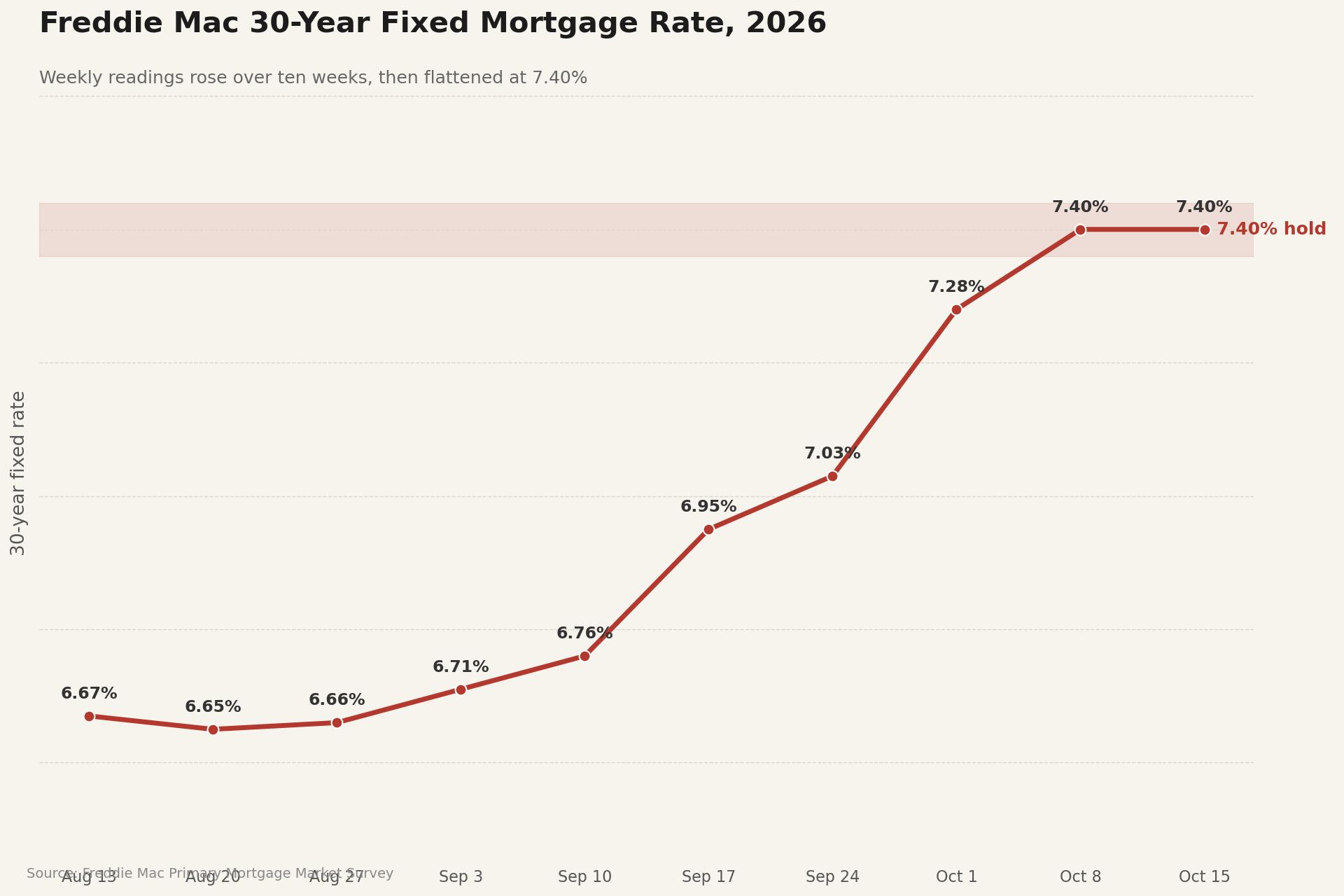
For the first time in nearly two months, the weekly mortgage rate survey for October 2026 showed no increase. Freddie Mac's Primary Mortgage Market Survey put the average 30-year fixed-rate mortgage at 7.40% for the week ending October 15, unchanged from the week before. That breaks a run of seven straight weekly increases that had carried the rate from 6.66% in late August to 7.40% in early October. It is a pause, not a reversal: a year ago, the same measure stood at 6.27%. The 15-year fixed-rate mortgage inched down to 6.71%, from 6.73% the prior week. "The average 30-year fixed-rate mortgage remained unchanged this week," said Sam Khater, Freddie Mac's chief economist, in the survey release.
What ended the streak
The climb was relentless: 6.66% for the week ending August 27, then 6.71%, 6.76%, 6.95%, 7.03%, 7.28%, and finally 7.40% for the week ending October 8, a gain of 75 basis points across seven weekly increases. We covered the 7.4% milestone itself when the streak was still running.
As we covered in our report on the MBA's 7.50% reading, a hotter-than-expected September inflation print, 3.7% year over year, sent bond markets repricing and raised the odds of another Federal Reserve hike at the October 28 meeting. A pause of one week does not change the direction of travel, but after seven straight increases it is the first sign the upward momentum may be taking a breather.
Two surveys, two numbers: PMMS vs. MBA
Freddie Mac says 7.40%, the Mortgage Bankers Association says 7.50%. Both are correct, because they measure different things over different weeks.
Freddie Mac's survey reports the average rate for the week ending October 15. The MBA's survey, for the week ended October 9, reports the average contract rate: what borrowers actually locked in the MBA's sample, reflecting a different mix of lenders and loan types. The practical takeaway: the Freddie Mac number is the steadier, widely cited weekly benchmark, while the MBA number tends to run slightly higher.
What demand looks like: applications keep falling
The rate pause has not, so far, revived demand. The MBA's survey for the week ended October 9 showed applications still shrinking: the seasonally adjusted Purchase Index fell 4%, its sixth straight weekly decline (down 0.2%, 1%, 1%, 4%, 2%, then 4%), and sits 16% below a year ago. The Market Composite Index, which measures total application volume, fell 2.7%, and the Refinance Index slipped 0.4% to 56% below a year ago.
The adjustable-rate mortgage share of applications reached 10.5%, its highest since October 2025, as more borrowers trade rate certainty for a lower initial payment. The refinance share was 37.7% of total applications, up from 37.0% the prior week.
MBA deputy chief economist Joel Kan summed it up: "Mortgage applications decreased as rates moved higher last week. The 30-year fixed rate was 7.5 percent, the highest rate since November 2023 and more than a percentage point higher than a year ago." With demand cooling, rental concessions are also rebounding, another lever for households on the fence.
Yun: it is a demand problem, not a supply problem
The demand story got its bluntest telling from NAR chief economist Lawrence Yun, speaking at a press conference in the week of October 12. "Higher mortgage rates are clearly making it more difficult for home buyers," he said, citing lockbox data showing visits to homes for sale were down 20% in September from a year earlier, and concluded: "Low sales activity is clearly due to lack of demand, not limited supply."
"It's no longer a supply issue. Higher mortgage rates are reducing foot traffic," Yun said, adding: "Mortgage rates are a magical factor that drives sales or holds back sales." He also said rates of 7% or higher are likely the new normal for the foreseeable future, with no major drop coming.
What the price data says for buyers
Realtor.com's September 2026 housing report found that 20.8% of active listings had a price cut, up 0.9 percentage points from a year earlier and the highest September reading since 2018, as well as the yearly high.
The national median listing price was $419,250 in September, down 1.4% from a year ago, the 11th consecutive month of annual list-price declines. Active listings rose 5.4% to 1,161,615 while new listings totaled 394,830, down 0.7% year over year. Homes spent a median of 61 days on market, and the stock of homes under contract fell 4.1% year over year, its second straight monthly decline.
Realtor.com chief economist Danielle Hale put it this way: "September's housing data shows that buyers are gaining leverage, but higher mortgage rates are limiting how much of that opportunity they can use." Sellers are cutting prices and inventory is building, which should favor buyers, but financing at 7.4% eats much of the advantage, as Yun's lockbox data confirms: foot traffic is down 20%.

What this means for buyers right now
For buyers, the market is genuinely two-sided. Financing costs are painful and, as October 2026's mortgage rates show, unlikely to fall soon: Yun expects rates of 7% or higher to persist, and the Fed's October 28 meeting could move them again, as we covered in our prior coverage of the inflation report and the MBA's 7.50% reading. But sellers are cutting prices at the highest September rate since 2018 while listings sit longer and inventory rises, which is negotiating leverage that has not existed in years. A one-week hold is not a signal to wait for lower rates. Buyers who can stay flexible may find renting the stronger play right now.
Frequently Asked Questions
What is the current 30-year mortgage rate?
Freddie Mac's weekly survey put the average 30-year fixed rate at 7.40% for the week ending October 15, 2026, unchanged from the prior week. The MBA's survey for the week ended October 9 reported a 7.50% average contract rate.
What ended the streak of rate increases?
The Freddie Mac survey held at 7.40% for the week ending October 15, ending seven straight weekly increases that had carried the rate from 6.66% in the week ending August 27.
What did Lawrence Yun say about mortgage rates?
NAR chief economist Lawrence Yun said: "Higher mortgage rates are clearly making it more difficult for home buyers." He cited lockbox data showing home visits down 20% in September year over year, said "Low sales activity is clearly due to lack of demand, not limited supply," and said rates of 7% or higher are likely the new normal with no major drop coming.
What do the latest purchase application numbers show?
The MBA's seasonally adjusted Purchase Index fell 4% in the week ended October 9, its sixth straight weekly decline, and sits 16% below a year ago. The ARM share of applications hit 10.5%, its highest since October 2025.
What does the price-cut data mean for buyers?
Realtor.com reported 20.8% of active listings had price cuts in September, the highest September reading since 2018, with a median listing price of $419,250, down 1.4% year over year. As chief economist Danielle Hale said, "buyers are gaining leverage, but higher mortgage rates are limiting how much of that opportunity they can use."
This article summarizes published mortgage-rate and housing data as of October 2026. Rates move daily; nothing here is financial advice.