Freddie Mac: 30-Year Mortgage Rate Drops to 7.32%, First Weekly Decline Since August

Mortgage rates finally moved in buyers' favor. The 30-year fixed-rate mortgage averaged 7.32% as of October 22, 2026, down from 7.40% the week before, according to Freddie Mac's Primary Mortgage Market Survey. The eight basis point drop is the first weekly decline since the week ending August 20, ending a two-month climb that pushed rates to a 52-week high.
The decline is modest, but for a market that has moved in only one direction for weeks, even a small break matters. "The average 30-year fixed-rate mortgage declined this week, offering some relief to prospective homebuyers," said Sam Khater, Freddie Mac's Chief Economist, in the October 22 release.
It is worth noting what the survey measures. The PMMS tracks conventional, conforming, fully amortizing home purchase loans for borrowers who put 20% down and have excellent credit, per Freddie Mac. Your quoted rate may differ based on credit, down payment, and loan type.
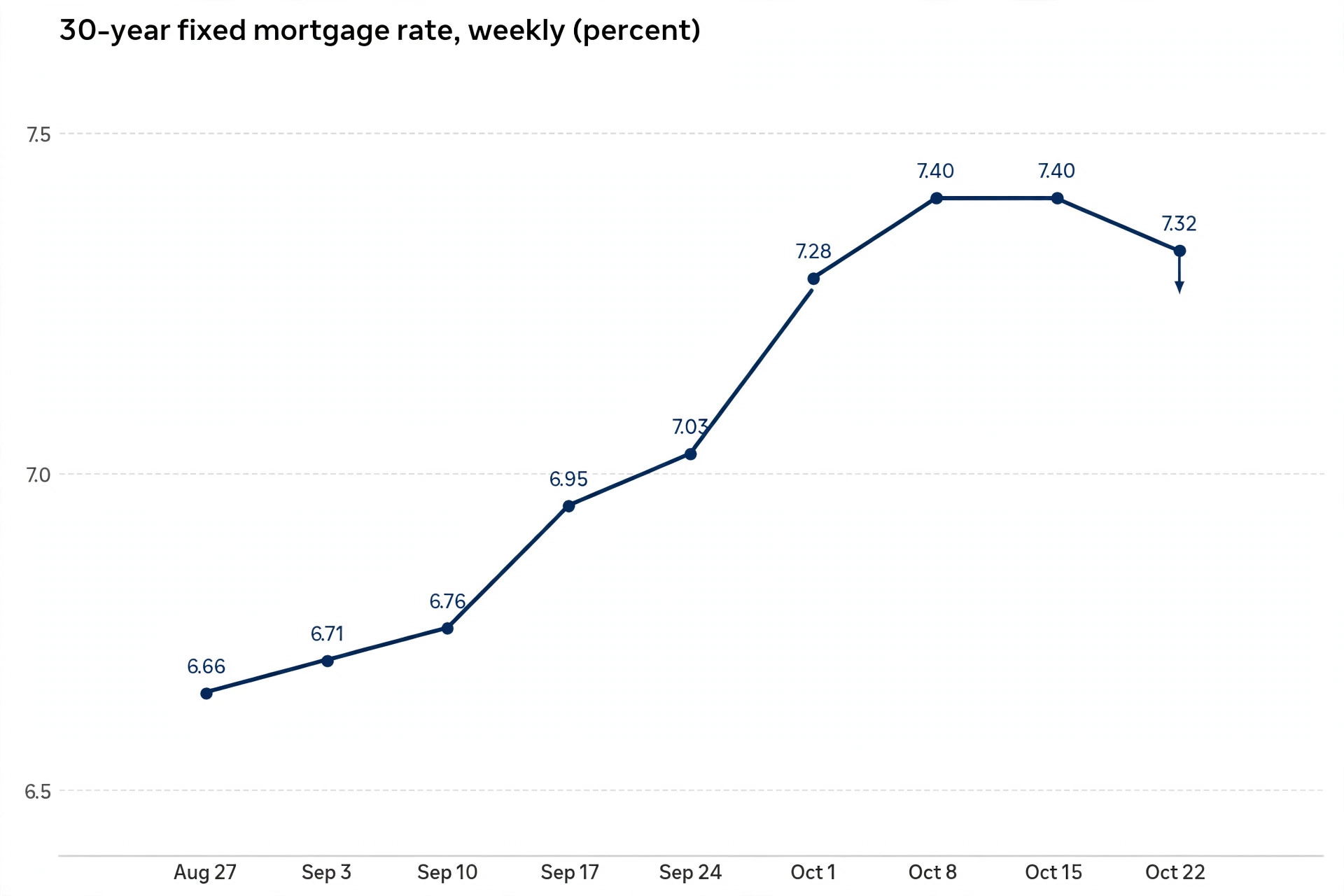
Eight weeks of climbing, then a break
To appreciate this week's reading, it helps to see how we got here. Weekly data from the Federal Reserve's FRED series MORTGAGE30US, which republishes Freddie Mac's survey, tells the story: 6.67% on August 13, a dip to 6.65% on August 20, then a climb every single week through October 8. The readings marched upward from 6.66% on August 27 to 6.71%, 6.76%, 6.95%, 7.03%, and 7.28%, before landing at 7.40% on October 8.
Last week's reading held flat at 7.40%, and October 22 finally broke the streak. At 7.40%, the rate had set the 52-week high, first hit October 8; the trailing 52-week low is 5.98%, recorded February 26, 2026, per the same FRED series. The current 7.32% reading sits just below that high.
The 15-year fixed-rate mortgage also eased, averaging 6.68%, down from 6.71% the week before, according to Freddie Mac. That is a three basis point weekly decline.
Still far above last year
The relief is real but relative. A year ago at this time, the 30-year averaged 6.19% and the 15-year averaged 5.44%, per Freddie Mac's release. Today's 7.32% is 113 basis points higher than that 6.19% year-ago reading, and the 15-year at 6.68% is 124 basis points above its 5.44% year-ago mark.
In other words, buyers are still borrowing at rates more than a full percentage point above last fall. The weekly drop changes the direction, not the era.
The broader context sits with bond yields. The U.S. Treasury's daily par yield curve shows the 10-year yield at 4.96% on October 22, 2026. Earlier in the month, the 10-year reached 5.31% on October 5, topping the 5.30% mark. Mortgage rates tend to follow the 10-year, so the yield's move off its early-October peak is consistent with this week's rate decline.
What this means for buyers
First, the math. On a $400,000 loan over 30 years, the move from 7.40% to 7.32% drops the monthly principal and interest payment from $2,769.52 to $2,747.72, a difference of $21.80 per month, about $22. That excludes taxes, insurance, and fees. It is not a life-changing sum, but it is real money every month, and on larger loan amounts the savings scale up.
Second, the direction matters as much as the dollars. Rates rose every week for six straight weeks, and this is the first print since mid-August to move lower. For buyers who have been waiting on the sidelines, even a one-week break in the climb is a better signal than the unbroken rise that preceded it.
Third, watch the Federal Reserve. The Fed's official 2026 meeting calendar lists a two-day FOMC meeting October 27-28, with the policy decision and statement landing on Wednesday, October 28. (The calendar notes each meeting date is tentative until confirmed at the preceding meeting.) Mortgage rates respond to expectations about Fed policy and inflation, so next week's decision could set the tone for November.
What should you actually do? If you are actively shopping, this is not a reason to rush, and one week of decline is not yet a trend. But it is a reminder to keep your financing ready: if rates continue easing, buyers who can move quickly on a home they like will benefit first. If you are refinancing, most homeowners who locked in below 7% earlier this year are still better off where they are. The real refinancing math starts to change only if declines stack up over several weeks.
For more context on this week's path, see our coverage of last week's 7.40% hold, the September climb past 7.4%, and rates at 7.5% earlier in the cycle.
Frequently Asked Questions
What is the 30-year mortgage rate as of October 22, 2026?
The 30-year fixed-rate mortgage averaged 7.32% as of October 22, 2026, down from 7.40% the week before, according to Freddie Mac's Primary Mortgage Market Survey.
How much did mortgage rates drop this week?
The 30-year rate fell eight basis points (from 7.40% to 7.32%), and the 15-year rate fell three basis points (from 6.71% to 6.68%), per Freddie Mac.
Is this the first weekly decline in a while?
Yes. It is the first weekly decline since the week ending August 20, according to Federal Reserve FRED data on Freddie Mac's survey series. Rates rose every week from August 27 through October 8, then held flat at 7.40% on October 15.
How do current rates compare to a year ago?
A year ago, the 30-year averaged 6.19% and the 15-year averaged 5.44%, per Freddie Mac. Current rates are 113 and 124 basis points higher, respectively.
How much does the rate drop save on a typical loan?
On a $400,000 30-year loan, the drop from 7.40% to 7.32% lowers the monthly principal and interest payment by $21.80, about $22 per month, before taxes and insurance.
What is driving mortgage rates right now?
Mortgage rates generally track the 10-year Treasury yield. The U.S. Treasury's daily data shows the 10-year at 4.96% on October 22, down from 5.31% on October 5. The Federal Reserve's October 27-28 meeting is the next event that could shift the outlook.
What exactly does Freddie Mac's survey measure?
The PMMS covers conventional, conforming, fully amortizing home purchase loans for borrowers who put 20% down and have excellent credit. Borrowers with lower credit scores, smaller down payments, or other loan types will see different quoted rates.