Fannie Mae Raises 2027 Mortgage Rate Forecast to 7.5% From 6.7%

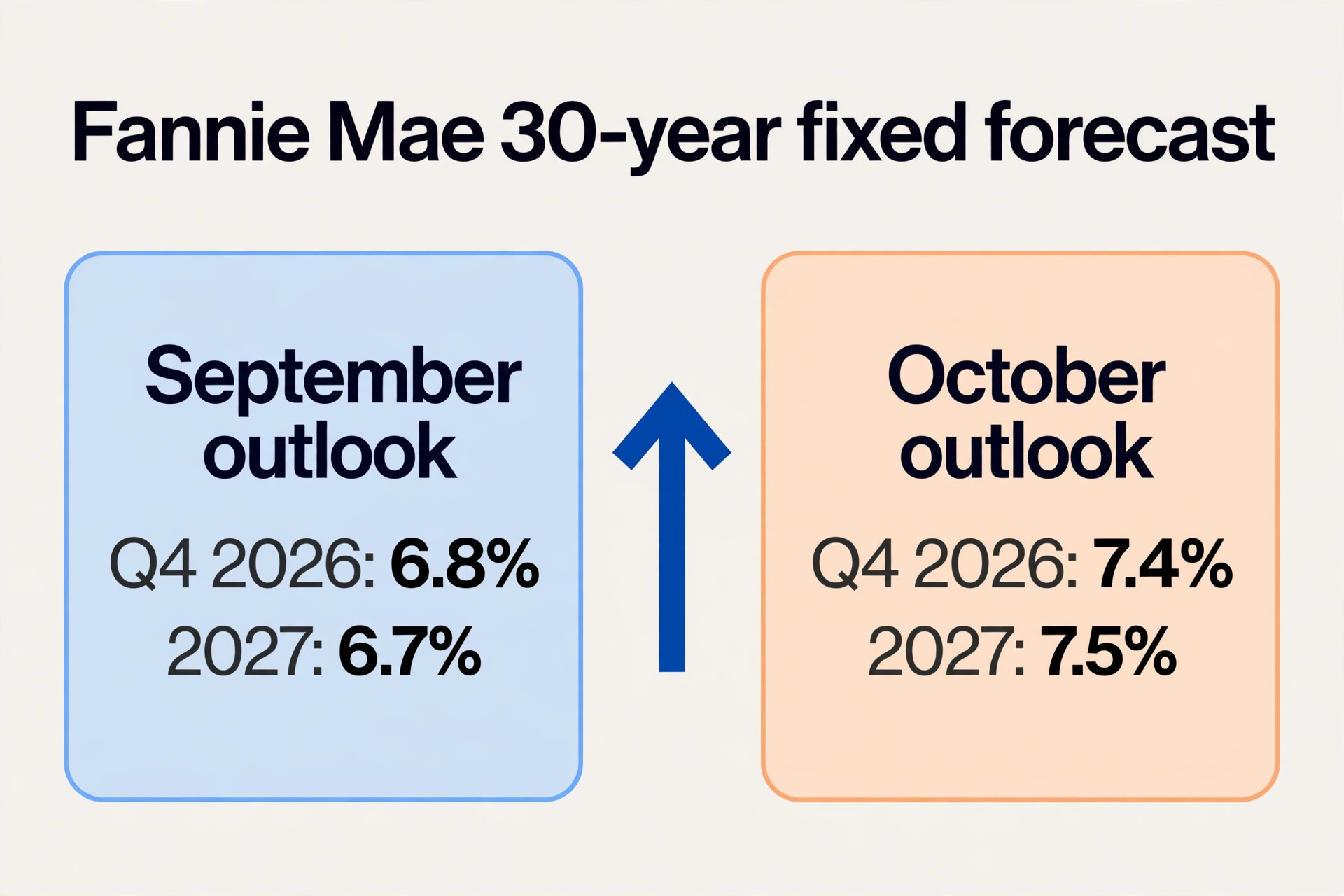
Fannie Mae, the government-sponsored mortgage company, has sharply raised its mortgage rate outlook. Its October 2026 Economic and Housing Outlook, published this Wednesday (October 14, 2026), now projects the average 30-year fixed mortgage rate at 7.4% in the fourth quarter of 2026 and 7.5% in every quarter of 2027. Just a month earlier, its September outlook had those figures at 6.8% for Q4 2026 and 6.7% across 2027. The revision adds 0.6 percentage points to the Q4 2026 forecast and 0.8 percentage points to the full-year 2027 forecast.
The forecast tables are dated October 12, 2026, and note that interest rate forecasts are based on rates from September 30, 2026, while all other forecasts are based on the October 12 date. The September tables, dated September 11, used rates from August 31.
The new forecast, quarter by quarter
Fannie Mae's Economic and Strategic Research Group publishes these numbers each month in its Housing Forecast table. Here is what the October edition shows for the 30-year fixed rate mortgage:
| Period | September outlook | October outlook | |---|---|---| | Q4 2026 | 6.8% | 7.4% | | Q1 2027 | 6.7% | 7.5% | | Q2 2027 | 6.7% | 7.5% | | Q3 2027 | 6.7% | 7.5% | | Q4 2027 | 6.7% | 7.5% | | 2027 annual | 6.7% | 7.5% |
The October table also shows the 2026 annual average 30-year fixed rate at 6.7%, up from the 6.5% shown in September. Remember that the Q4 2026 and 2027 figures are forecasts, not observed rates: the forecast documents state that shaded areas of the tables denote forecasts and unshaded areas denote actuals.
Other Fannie Mae forecasts moved the same direction
The October outlook moved more than the mortgage rate. In its own Economic Forecast table, Fannie Mae raised its 10-year Treasury note yield forecast for Q4 2026 from 4.8% (in September) to 5.3% (in October), and the 2027 annual average from 4.9% to 5.3%. Its Consumer Price Index forecast rose as well: Q4 2026 inflation at 3.7% year over year in the October edition, versus 3.4% in September, with the 2026 annual CPI also moving from 3.4% to 3.7%.
These are Fannie Mae's own forecast-table figures. They moved alongside the mortgage rate revision in the same edition, and we present them as the forecaster's own numbers rather than as an explanation of why the revision happened.
Fannie Mae did not publish a reason this month
One important note on sourcing: the October 2026 outlook shipped only the Economic Forecast and Housing Forecast tables. Fannie Mae's forecast archive lists no news release, narrative commentary, or "Developments" document for the October edition, so there is no Fannie Mae-stated reason for the rate revision to quote. You may see other coverage offering its own framing for why forecasts are moving; that framing does not come from Fannie Mae, and we will not attribute it to Fannie Mae.
Fannie Mae also includes its standard caution in both documents: the ESR Group's views are based on a number of assumptions, are subject to change without notice, and "do not necessarily represent the views of Fannie Mae or its management."
Whose forecast this is, and whose it is not
Attribution matters here, because three different institutions put out numbers that look similar but are not the same thing.
These numbers are Fannie Mae's, from its Economic and Strategic Research Group. They are separate from the Mortgage Bankers Association's forecasts, which we covered in our October 15 reporting: the MBA's October forecast expects the 30-year rate to average 7.3% in Q4 2026 and stay above 7% through 2027. The MBA and Fannie Mae use different assumptions and publish different numbers, and the two should not be mixed.
Neither Fannie Mae's nor the MBA's numbers are current observed rates. For that, the reference point is Freddie Mac's Primary Mortgage Market Survey, which showed the 30-year fixed-rate mortgage averaging 7.40% for the week ending October 8, 2026, up from 7.28% the prior week, with the 15-year fixed at 6.73%. A year earlier, the 30-year averaged 6.30%.
What the revised forecast means for buyers
Fannie Mae now sees rates holding near current levels rather than drifting down into the high 6s next year. For buyers, that shifts the planning assumptions.
Rate locking. If you are under contract with a closing date approaching, the forecast supports the cautious view: waiting for a meaningful dip has not been rewarded this year, and Fannie Mae no longer expects one in the next 15 months. A lock near today's levels now lines up with what one major forecaster expects for the fourth quarter. Floating is a bet that the data breaks your way before closing, and this month's revision went the other way. None of this is financial advice; talk to your lender about your specific timeline and lock terms.
Buying timing. Buyers who hoped a late-2026 dip would soften financing costs may need to reset expectations. The flip side is leverage: as rates have risen, demand has softened, and buyers who can still transact are negotiating in a friendlier environment than the bidding wars of lower-rate years.
2027 plans. The mortgage rate forecast for 2027 now holds 7.5% flat through all four quarters of 2027, with no easing in sight within that horizon. If you are planning a purchase next year, budgeting at the top of recent ranges rather than the bottom is the more defensible assumption, at least by Fannie Mae's math. And if rates surprise to the downside, you can always revisit, while refinancing later remains an option if and when rates do come down.

Frequently Asked Questions
What changed in Fannie Mae's October forecast?
Fannie Mae's October 2026 Economic and Housing Outlook, published October 14, raised the average 30-year fixed mortgage rate forecast to 7.4% for Q4 2026 (from 6.8% in September) and 7.5% for every quarter of 2027 (from 6.7% in September). The 2027 annual average moved from 6.7% to 7.5%.
What exactly is Fannie Mae's new 30-year rate forecast?
The October Housing Forecast projects 7.4% in Q4 2026 and 7.5% in Q1, Q2, Q3, and Q4 of 2027, with 7.5% as the 2027 annual average and 6.7% as the 2026 annual average. These are forecasts, not observed rates.
How does this compare to the September forecast?
The October revision is up 0.6 percentage points for Q4 2026 (6.8% to 7.4%) and up 0.8 percentage points for the 2027 annual average (6.7% to 7.5%). Its 10-year Treasury and CPI forecasts also moved up between the two editions.
Did Fannie Mae explain why it raised the forecast?
No. The October 2026 outlook shipped only forecast tables, with no narrative commentary or news release. There is no Fannie Mae-stated reason for the revision to quote.
What does the revision mean for locking a rate?
It weakens the case for floating: a major forecaster that expected rates in the high 6s next year now expects 7.5%. If you are under contract, a lock near current levels matches Fannie Mae's Q4 outlook. This is not financial advice; discuss your timeline with your lender.
What does it mean for buyers planning a 2027 purchase?
Fannie Mae now projects 7.5% flat through all of 2027, so budgeting at recent highs rather than hoping for a dip is the more conservative planning assumption. If rates surprise lower, you can adjust later.
This article summarizes published mortgage-rate forecasts as of October 2026. Forecasts are based on assumptions and are subject to change; nothing here is financial advice.