Brisbane Turns Buyer's Market as House Prices Tipped to Keep Falling
Brisbane's long property boom has definitively turned. Home values fell for a fourth straight month in September, and at 1.5 per cent, the city recorded the steepest monthly drop of any capital. Auction clearance rates have collapsed to the lowest of any capital city, and economists now expect prices to keep falling at least through the end of the year. For buyers, it is the most favourable market Brisbane has seen in seven years. For sellers, the message from agents is blunt: price for the market you have, not the one you wish you had.
Where Brisbane prices stand now
Cotality's October Home Value Index shows Brisbane dwelling values fell 1.5 per cent in September, the steepest monthly drop of any capital city. The median Brisbane home value now sits at $1,048,880, roughly $59,000 below where it stood in May. Nationally, values fell 1.1 per cent in September, the sixth consecutive monthly decline, leaving national values 3.9 per cent lower over the September quarter.
The house segment tells the sharper story. Brisbane house values fell 1.5 per cent in the month to a median of $1,146,078, down $34,474 from August alone. The quarterly fall has deepened to 4.9 per cent, and annual growth has collapsed from 10.3 per cent to 5.3 per cent in a single quarter. Units are holding up slightly better on an annual basis, but the monthly direction has turned negative there too: down 1.4 per cent in September to a median of $834,627.
The downturn is remarkably broad. Cotality's Tim Lawless notes that 97 per cent of capital city suburbs recorded value falls in the three months to September. In Brisbane, the pain comes from two forces landing at once: four RBA rate rises in 2026 and the federal budget's tax changes targeting investors. Ray White economist Atom Go Tian says investors have definitely pulled back, but the unintended consequence is that first home buyers and owner occupiers are pulling back as well. Real Estate Institute of Queensland chief executive Antonia Mercorella agrees the tax reforms have dented confidence, even if they are not the only reason the market has turned.
For context on how this correction began, see our overview of Australia's housing downturn in 2026.
The two suburbs still rising, and the ones taking the biggest hits
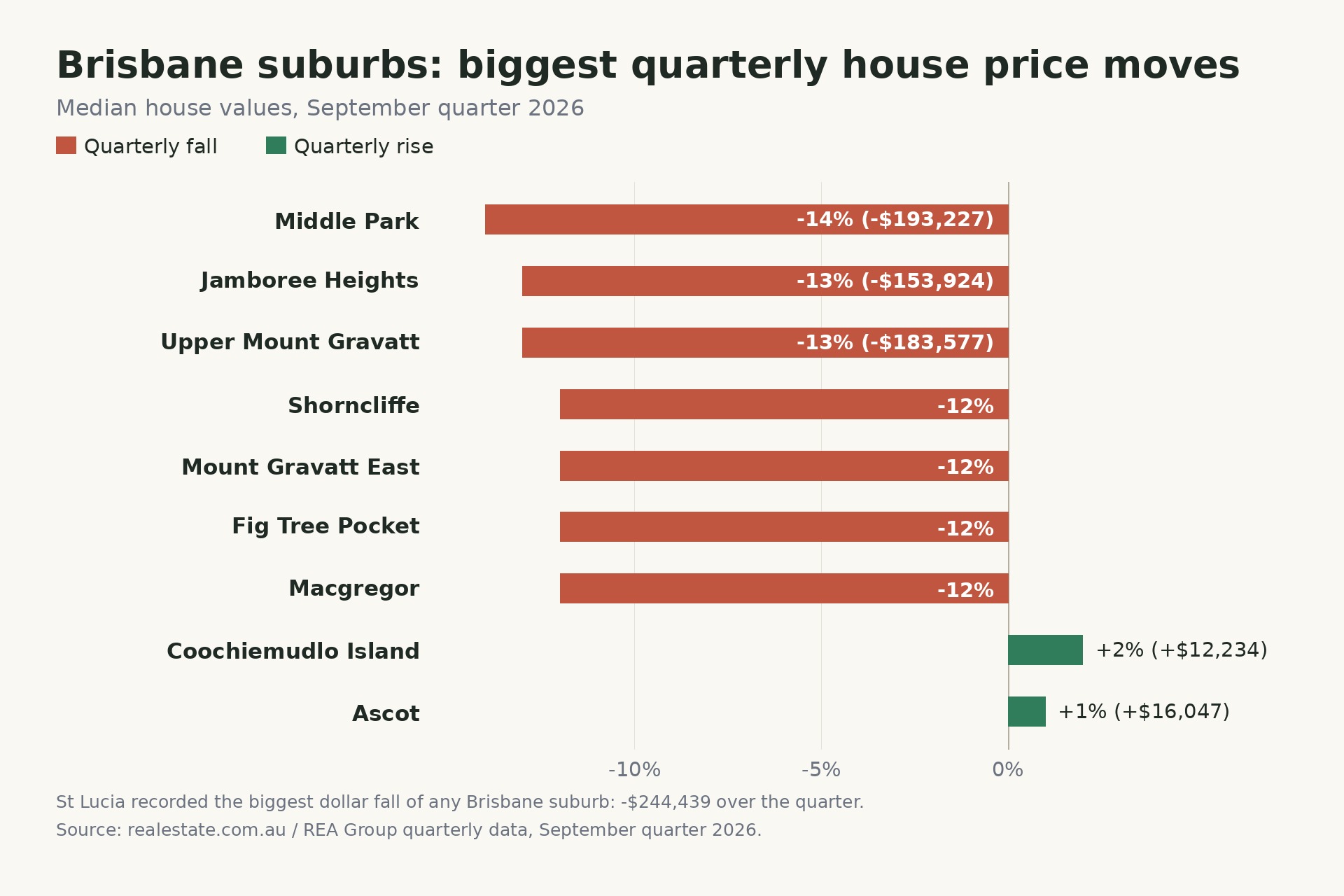
This is where Brisbane's story gets interesting. Fresh quarterly data from realestate.com.au (REA Group) shows nine out of ten Queensland suburbs fell in value in the September quarter. But within Greater Brisbane, exactly two suburbs recorded a rise in median house values: blue-chip Ascot, up $16,047 (1 per cent), and Coochiemudlo Island in Moreton Bay, up $12,234 (2 per cent). Everywhere else went backwards.
The falls, however, are very uneven. The biggest quarterly losses were concentrated in Brisbane's middle ring:
- Middle Park lost $193,227 (14 per cent) from its median house value
- Jamboree Heights fell $153,924 (13 per cent)
- Upper Mount Gravatt dropped $183,577 (13 per cent)
- Shorncliffe, Mount Gravatt East, Fig Tree Pocket and Macgregor each fell 12 per cent
- St Lucia recorded the biggest dollar fall of any Brisbane suburb: $244,439 over the quarter
The unit market is under pressure in every suburb, with Corinda, Keperra, Grange and Manly each down 10 per cent or more. In Logan, Waterford West units dropped 12 per cent, while Ipswich's Darra house market fell $129,994.
Why are Ascot and Coochiemudlo Island the exceptions? REA Group economist Luc Redman points to the pattern seen nationally: the highest end of the market has suffered the largest downturn, but blue-chip, tightly held pockets with strong owner-occupier demand and lifestyle appeal are proving more resilient. Ascot's prestige stock barely trades, which cushions its median, while Coochiemudlo Island's small island market marches to its own beat. Regional Queensland is also holding up better on affordability grounds: Townsville recorded eight suburbs with quarterly gains and Cairns had 21.
Why Brisbane is a buyer's market now
A buyer's market is not just about falling prices. It is about the balance of power, and every indicator in Brisbane now favours the buyer.
First, auctions have dried up as a competitive arena. Brisbane recorded a preliminary auction clearance rate of just 19.6 per cent for the week ending October 4, the lowest of all capital cities (Sydney managed 37 per cent, Melbourne 50 per cent). Buyers across south-east Queensland are reporting open homes with virtually no competition, in some cases turning up to find they are the only attendees.
Second, choice has exploded while urgency has vanished. Total housing stock for sale sits 23.1 per cent above last year's levels, even though new listings are down 9.2 per cent. That combination means homes are simply taking longer to sell: the median capital city selling time is now 39 days, up from 23 days a year ago.
Third, the frenzy-era bidding wars are over. Buyer's agent Jack Freestone says that before the budget, three to six or more written offers on every property was normal. Now a good property draws one to three. He calls it "more of a normal market now": buyers no longer have to offer tens of thousands above the asking price, though genuine bargains remain rare.
Place Estate Agents chief executive Damian Hackett goes further, describing current conditions as the most favourable Brisbane buyers have seen in seven years. Sellers, meanwhile, are being warned to drop the denial. As one prominent auctioneer put it recently, in a falling market the overpriced listing does not hold its value, it chases the market down, and the early buyer you reject today may be better than the one you accept three months later.
What buyers should do
For buyers, the playbook in a buyer's market is straightforward, but it rewards patience and preparation rather than aggression.
Get your finance sorted before you shop. With the cash rate at 4.60 per cent and lenders repricing, borrowing capacity is the binding constraint. Canstar estimates this year's four hikes have cut about $47,400 from the borrowing capacity of someone on the average full-time wage of $108,650. Know your real number before you fall in love with a house.
Do not try to time the exact bottom. Economists expect falls to continue at least through the end of the year, but picking the trough precisely is a fool's errand. If you find the right home at a price your budget handles comfortably, even if rates rise once more, that matters more than squeezing out the last 2 per cent.
Use the extra time on market to your advantage. Longer selling times mean you can insist on building and pest inspections, negotiate on price, and walk away from anything with red flags. In the boom, buyers waived conditions to win. In this market, conditions are your leverage.
Target the segments under the most pressure. The data shows middle-ring houses and units taking the biggest quarterly hits, while blue-chip pockets hold firm. If your budget stretches to a suburb down 12 to 14 per cent in a quarter, you are negotiating from strength.
What sellers should do
For sellers, the strategy inverts. Price realistically from day one. The evidence is clear that overpriced listings in a falling market chase prices down rather than holding them. An early, realistic offer today is often better than a lower one three months from now.
Present the property at its absolute best. With buyers spoiled for choice and taking 39 days on average to decide, anything tired or poorly presented sits. The properties still moving are the ones where presentation and realistic pricing meet.
Consider timing against the RBA calendar below. Listing into a rising-rate environment means each month can bring a smaller buyer pool. If you must sell this year, sooner is generally better than later while falls are forecast to continue.
The RBA decision on November 3: the next catalyst
Everything now hinges on the Reserve Bank. The cash rate sits at 4.60 per cent after the Board's 25 basis point hike on September 29, the fourth rise of 2026. Governor Michele Bullock said inflation remains too high, with upside risks from the Middle East conflict and global energy prices now materialising, and the Board will raise rates again if needed.
The next decision lands on Tuesday, November 3 (Melbourne Cup Day), two days after the September quarter CPI print on October 28. ANZ is forecasting a further 25 basis point rise to 4.85 per cent, though that remains a forecast, not a decision.
For Brisbane property, the RBA call is the swing factor. Luc Redman says the near-term path is really determined by what the RBA does: the September rise still needs to flow through, and he expects price falls at least to the end of this year and probably into early next year before the market moderates. The longer-term floor looks more constructive: Olympic and infrastructure spending gives Brisbane support that other cities lack, and Redman expects a return to growth eventually, just more moderate than the boom of the past six years.
Frequently Asked Questions
Is Brisbane in a buyer's market right now?
Yes. Prices are falling across nearly every suburb, auction clearance rates are the lowest of any capital city at 19.6 per cent, listings sit 23.1 per cent above last year's levels, and selling times have blown out from 23 to 39 days. Buyers face little competition and hold the negotiating power.
Which Brisbane suburbs are still rising in value?
Only two: Ascot (up 1 per cent, or $16,047) and Coochiemudlo Island (up 2 per cent, or $12,234) in the September quarter, according to REA Group data. Every other Greater Brisbane suburb recorded a fall in median house values.
Which Brisbane suburbs fell the most?
Middle Park led the declines, losing $193,227 (14 per cent) in the September quarter, followed by Jamboree Heights ($153,924, down 13 per cent) and Upper Mount Gravatt ($183,577, down 13 per cent). St Lucia had the biggest dollar fall at $244,439.
How far will Brisbane house prices fall?
Cotality data shows Brisbane house values down 4.9 per cent over the September quarter. REA Group economist Luc Redman expects falls to continue at least through the end of 2026 and probably into early 2027, with the path heavily dependent on the RBA's next moves. Some economists see scope for a peak-to-trough fall of about 10 per cent nationally.
Should I buy now or wait for prices to fall further?
If you are buying a home to live in and the repayments are comfortable even if rates rise once more, buying now in a buyer's market has real advantages: less competition, more time for due diligence, and genuine negotiating power. Waiting for the exact bottom risks missing the turn, and no economist will pick it precisely. Investors should weigh the negative gearing and CGT rule changes taking effect in 2027.
This article summarizes published property data and forecasts as of October 2026. Markets move; nothing here is financial advice.