Australian Mortgage Demand Falls 19.2% in September 2026 as First-Home Buyer Applications Drop 22.1%

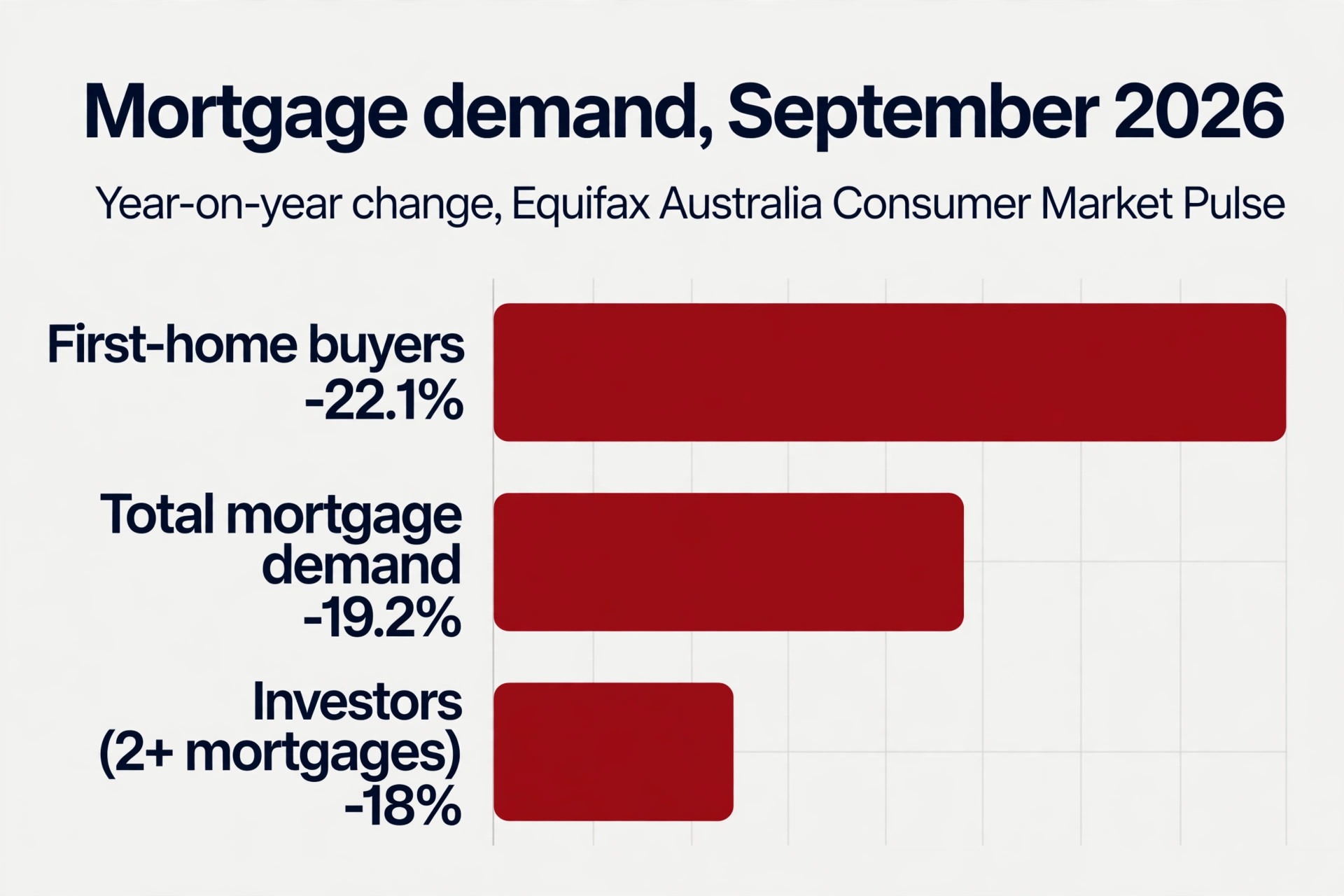
Australian mortgage demand fell 19.2% year over year in September, the sixth consecutive monthly decline and the weakest result since October 2022, according to Equifax's Consumer Market Pulse. The number that should worry policymakers most is who is leaving: first-home buyer applications fell 22.1%, the largest annual decline since December 2022, even though the May budget's tax reforms were sold as a way to level the playing field for them.
The September figures were issued by Equifax in mid-October and reported consistently across brokernews, realestate.com.au, and AAP; Equifax's own site had not published the September report at the time of writing. One caveat up front: this is lender-side demand data, the inquiries that come before applications, not settled loan approvals. The signal it gives is still hard to ignore, because the direction is the same in every segment Equifax tracks.
First-home buyers are falling hardest
The first-home buyer slide has now deepened three months in a row. Equifax puts September's decline at 22.1% year over year, steeper than 20.1% in August and 19.2% in July. Kevin James, Chief Solutions Officer at Equifax Australia, called it "the largest year-on-year decline in first home buyer mortgage demand since December 2022," adding that "baseline prices for properties remain high despite recent market dips."
At the same time, the average first-home buyer mortgage has reached a record $743,000. James told AAP: "For many prospective entrants, bridging the deposit and repayment threshold is likely becoming increasingly difficult without institutional or familial support."
In one line: first-home buyer demand fell 22.1% in September while the average first-home buyer loan hit a record $743,000. Fewer buyers, bigger loans.
The pullback is being led by younger borrowers. Applications from 18 to 25-year-olds fell 25% year over year, and applications from 26 to 35-year-olds fell 22.5%. Demand fell in every state: NSW was down 21.2% and the ACT 21%, the steepest falls in the country. For buyers still determined to get in, our comparison of the Help to Buy and 5% Deposit Scheme lays out what the remaining government pathways actually cover.
Investors are retreating too, after a false spring
Demand among potential investors, borrowers with two or more mortgages, fell 18% year over year in September. That followed an 11.4% fall in August, which had itself been an improvement on July's 15.1% decline. The August recovery was real in Equifax's own data, and September reversed it completely: a genuine second leg down, not a reporting quirk.
Investors were the stated target of the May budget's negative gearing and capital gains tax changes, so their retreat is the least surprising part of the release. The surprise is the section above it. Reforms meant to push investors aside and open room for owner-occupiers are coinciding with the steepest first-home buyer drop in nearly four years. Our full breakdown of the negative gearing and CGT overhaul explains what changed and when it takes effect.
Refinancers are stuck where they are
Refinancing with an existing lender dropped 28% year over year in September, and switching to a different lender declined 8.8%. James linked the slowdown to serviceability: strict serviceability assessments appeared to be stopping many borrowers from moving, even when they wanted a better rate, "effectively locking them into their current arrangements."
His summary of the whole release is blunt: "Rather than taking on expanded debt commitments in a sustained high-rate environment, Australian households are taking a decisive step back."
The RBA minutes tell the same story
The Reserve Bank's minutes for its 28-29 September meeting, released 13 October, independently corroborate the squeeze. The board noted that scheduled mortgage payments had increased to around 10 per cent of household disposable income, around their 2024 peak, while extra payments into offset and redraw accounts were a little below their longer-run average. Households are paying more of their income to service debt and have less left over to get ahead.
The minutes go further: new housing loan commitments had fallen sharply, led by lending to investors, and weaker housing conditions were also likely to reflect recent tax changes and some reversal of the earlier strong rise in housing prices. A central bank does not name "recent tax changes" in its minutes unless they are visibly moving the data. For what the RBA might do next, see our preview of the November rate decision.
Why the May budget is biting before the reforms start
The negative gearing and CGT reforms are now law and apply from 1 July 2027. The Australian Taxation Office confirms they limit negative gearing for residential property investments to new builds, and replace the 50% CGT discount for individuals, trusts, and partnerships with cost base indexation and a 30% minimum tax rate on capital gains. Properties held at 7:30pm AEST on 12 May 2026 are exempt from the negative gearing changes.
But the practical impact is arriving through the bank's serviceability calculator, not the tax return. In a Firstlinks commentary in early October, mortgage broker Jade Xie wrote: "Australia's negative gearing reforms do not formally take effect until 1 July 2027, but many property investors are already feeling their first practical impact. It is not showing up on a tax return. It is showing up in the bank's serviceability calculator."
Since the 12 May 2026 Budget, lenders have changed how some investment properties are treated when assessing borrowing capacity. Xie's example is Macquarie's public broker guidance, which includes negative gearing in serviceability calculations for contracts entered into after 12 May only where the property qualifies as a new build that genuinely adds to housing supply. That is informed commentary, not a primary authority: the reform itself is confirmed by the ATO, and James's own observation about strict serviceability assessments locking borrowers into current arrangements supports the mechanism.
This is the bridge between the reform and the headline numbers. First-home buyers were supposed to be the winners of the reform, but the borrowing-capacity repricing is hitting everyone at once, and with the average first-home buyer loan at a record $743,000, new buyers are stretching further just to get through the bank's calculator.
What this means for buyers now
A few practical takeaways, none of them financial advice.
If you are considering refinancing, do the serviceability homework before you start. James's warning about borrowers being "locked in" is real, and an application that goes nowhere still costs time and a credit inquiry.
If you are a first-home buyer, the data says waiting is the crowd's choice and the record loan size says those still buying are stretching. Neither is a signal about where prices go next. It is a signal about who can still clear the bank's bar. That context also matters for Westpac's forecast that Australian home prices could fall 10%, which we covered earlier this month.
If you are an investor, any borrowing modelled on the old negative gearing rules needs to be re-run against new-build-only treatment for post-May contracts, because the bank's calculator has already moved even though the law has not.

Frequently Asked Questions
What did Equifax's September data show?
Total mortgage demand fell 19.2% year over year in September 2026, the sixth consecutive monthly decline and the weakest result since October 2022. First-home buyer applications fell 22.1%, the largest annual decline since December 2022. Investor demand fell 18%, same-lender refinancing fell 28%, and demand fell in every state. The figures come from Equifax's Consumer Market Pulse, reported in mid-October.
Why are first-home buyers falling fastest if the tax reforms were meant to help them?
Because the reforms are biting through borrowing capacity, not just through tax bills. Lenders have changed how investment properties are treated in serviceability calculations since the May budget, tightening who can borrow across the board, while the record $743,000 average first-home buyer loan means new buyers are stretching further to get in. The playing field was levelled by shrinking what many borrowers can borrow, not just what investors can deduct.
Are investors leaving the market too?
Yes. Demand from borrowers with two or more mortgages fell 18% year over year in September, reversing a brief August improvement. The Reserve Bank's September minutes separately note that new housing loan commitments fell sharply, led by lending to investors.
Are the negative gearing reforms already affecting borrowing?
According to the ATO, the reforms are law and apply from 1 July 2027. But mortgage broker commentary in Firstlinks, citing Macquarie's public broker guidance, reports that lenders have already changed serviceability treatment for investment properties bought under post-May contracts. So borrowing capacity is moving before the tax returns do.
What did the RBA say about housing in its September minutes?
The minutes, released 13 October, say scheduled mortgage payments have risen to around 10 per cent of household disposable income, near the 2024 peak, and that new housing loan commitments fell sharply, led by investors. The board also noted weaker housing conditions likely reflect recent tax changes and a reversal of earlier strong price rises.
Does this mean fewer home loans are being approved?
Not necessarily. Equifax's Consumer Market Pulse measures mortgage demand, the inquiries and applications at the front of the pipeline, not settled approvals. Demand falling across every segment is a strong signal, but it is a demand signal, and the approvals data may tell a different story when it arrives.
This article is based on Equifax's September 2026 Consumer Market Pulse figures as reported in mid-October 2026, the Reserve Bank of Australia's September monetary policy meeting minutes released 13 October 2026, and the Australian Taxation Office's guidance on the negative gearing and capital gains tax reforms. Nothing here is financial advice.