Lennar New-Build Defect Complaints: What the Lawsuits Allege, and the Checklist to Use Before You Close

Two lawsuits allege construction defects in Lennar new builds: the first, filed by the Seminole Tribe of Florida, covers 552 homes across seven Florida counties; the second, a proposed class action in South Carolina, centres on one model of house and an alleged second-floor problem.
Everything below about the lawsuits is allegation, not proven defect. The lasting value here is the checklist: the ten systems a general home inspection covers.
The Florida suit: 552 homes, seven counties
The Seminole Tribe of Florida sued Lennar Corporation in March 2025, according to the Tribe's counsel, Conrad and Scherer, L.L.P. The case, before Broward Circuit Judge David Haimes, covers 552 homes on Seminole land in Broward, Glades, Hendry, St. Lucie, Hillsborough, Lake and Collier counties.
The complaint alleges construction defects in every one of the 552 homes, including roofs that need replacing and health-threatening mold accumulation. It states that tribal members were, in the complaint's words, "constructively evicted from their houses due to unsafe living conditions arising from the design and construction-related defects in their dwellings."
According to the Tribe's counsel page, an amended complaint was filed September 10, 2025, accusing Lennar of intentional misconduct and fraud: the complaint's allegations, not findings. Lennar has moved to compel arbitration, arguing both sides are contractually bound to arbitrate first; no ruling is verified here. A Lennar spokeswoman quoted on the Tribe's counsel page said: "We take these concerns seriously and seek to work collaboratively with the Seminole Tribe to address them."
The South Carolina case: a sagging second floor
The second case is Thompson et al. v. CalAtlantic Group, LLC et al. Roy M. Thompson and Jennifer Thompson filed the complaint on March 14, 2024, in the South Carolina Court of Common Pleas for Dorchester County. The defendants are CalAtlantic Group, LLC and Lennar Carolinas, LLC.
The Thompsons' home is a "Georgetown model" house in Summerville, South Carolina, contracted in 2022 for $413,485.00 and closed on October 17, 2022. The complaint alleges that in 2023 the plaintiffs noticed the second floor was sagging and uneven in places. It states the defendants blamed an improper I-joist running the length of the second floor.
The causes of action pleaded are breach of contract, negligence, breach of warranty, the South Carolina Unfair Trade Practices Act, and a class action claim. The proposed class is all South Carolina owners of a "Georgetown model" house who have not discovered the deficient I-beam issue, or discovered it less than three years before filing. The complaint states the exact number is unknown but believed to be in the hundreds: its belief, not a counted number.
This is a proposed class action, not a certified class: no certification ruling, settlement, or finding on the merits is verified here, and the I-joist problem is an allegation only. The relief sought includes investigation and repair costs, diminished value, loss of use, fees and costs, expert witness fees, and treble damages under the South Carolina Unfair Trade Practices Act. No dollar amount is stated in the filing.

What Lennar says, and what its warranty covers
Lennar states on its own site that every new Lennar home in Texas is backed by a warranty covering workmanship, systems, and structure, with terms and exclusions in the warranty documents received with the home. Service requests go through Lennar Customer Care after move-in.
Lennar also states that before closing, a buyer usually walks the finished home with the Lennar team and flags anything that needs attention.
No statement from Lennar about the November 2026 complaints was found on Lennar's own channels as of November 6, 2026. The New York Post reported on November 4, 2026, that Lennar said in a statement to the Post that it "stands by [their] homes" and "takes seriously any concerns about their quality". That wording is reported by the Post, not verified on Lennar's own site.
What a new-home warranty typically covers
New-home warranties generally offer limited coverage on workmanship and materials for components such as windows, HVAC, plumbing and electrical systems, for specific periods, according to the Federal Trade Commission.
Typical durations are one year for workmanship and materials on most components; generally two years for HVAC, plumbing and electrical systems; and up to 10 years from some builders for "major structural defects", sometimes defined as problems that make a home unsafe.
Typical exclusions matter as much as the coverage. Most new-home warranties do not cover expenses an owner may incur as a consequence of a major construction defect or warranty repair, such as moving-out costs. They also typically do not cover household appliances, small cracks in brick, tile, cement or drywall, or manufacturer-warranted components.
To make a claim, the FTC advises reading the warranty first, filing as it instructs, putting the repair request in writing, and keeping records. Unresolved disputes usually go to mediation, then mandatory binding arbitration, which is less formal than court and can cost homeowners up to several thousand dollars depending on complexity.
The new-build inspection checklist
A general home inspection is a non-invasive, visual examination of accessible areas, designed to identify material defects: issues that may significantly affect value, or pose an unreasonable risk to people.
Know the limits. An inspection reflects observations on the date of inspection, not a prediction of future conditions, and will not identify concealed or latent defects. The inspector is not required to determine code compliance, the cause of any condition, the presence of mold, mildew or fungus, air quality, or environmental hazards, or to offer engineering services or judge structural adequacy.
The checklist below follows the InterNACHI Home Inspection Standards of Practice (last revised October 2017), with the same system list corroborated by ASHI. Each item is something the inspector must inspect.
Roof. Coverings, gutters, downspouts, vents, flashing, skylights, chimney and penetrations, plus the roof structure. Active leaks are flagged.
Exterior. Wall coverings, eaves, soffits, fascia, windows, exterior doors, flashing, trim, walkways, driveways, stairs, porches, decks, carports, railings, drainage and grading.
Basement, foundation, crawlspace and structure. Foundation, basement, crawlspace and structural components, including signs of movement such as sheetrock or brick cracks, out-of-square doors and unlevel floors.
Heating and cooling. Each system run on normal controls. A system that did not operate, or was inaccessible, is flagged.
Plumbing. Shut-off valves, water heating equipment, all fixtures run, all toilets flushed, sinks, tubs and showers drained, the drain, waste and vent system, and sump pumps.
Electrical. Service drop, conductors, meter, disconnect, panelboards, grounding and bonding, switches, fixtures, receptacles, AFCI and GFCI devices, and smoke and carbon-monoxide detectors.
Fireplace. Visible fireplaces and chimneys, lintels, damper doors operated where accessible, and cleanout doors and frames.
Attic, insulation and ventilation. Insulation and ventilation in unfinished spaces, and mechanical exhaust in kitchen, bathrooms and laundry.
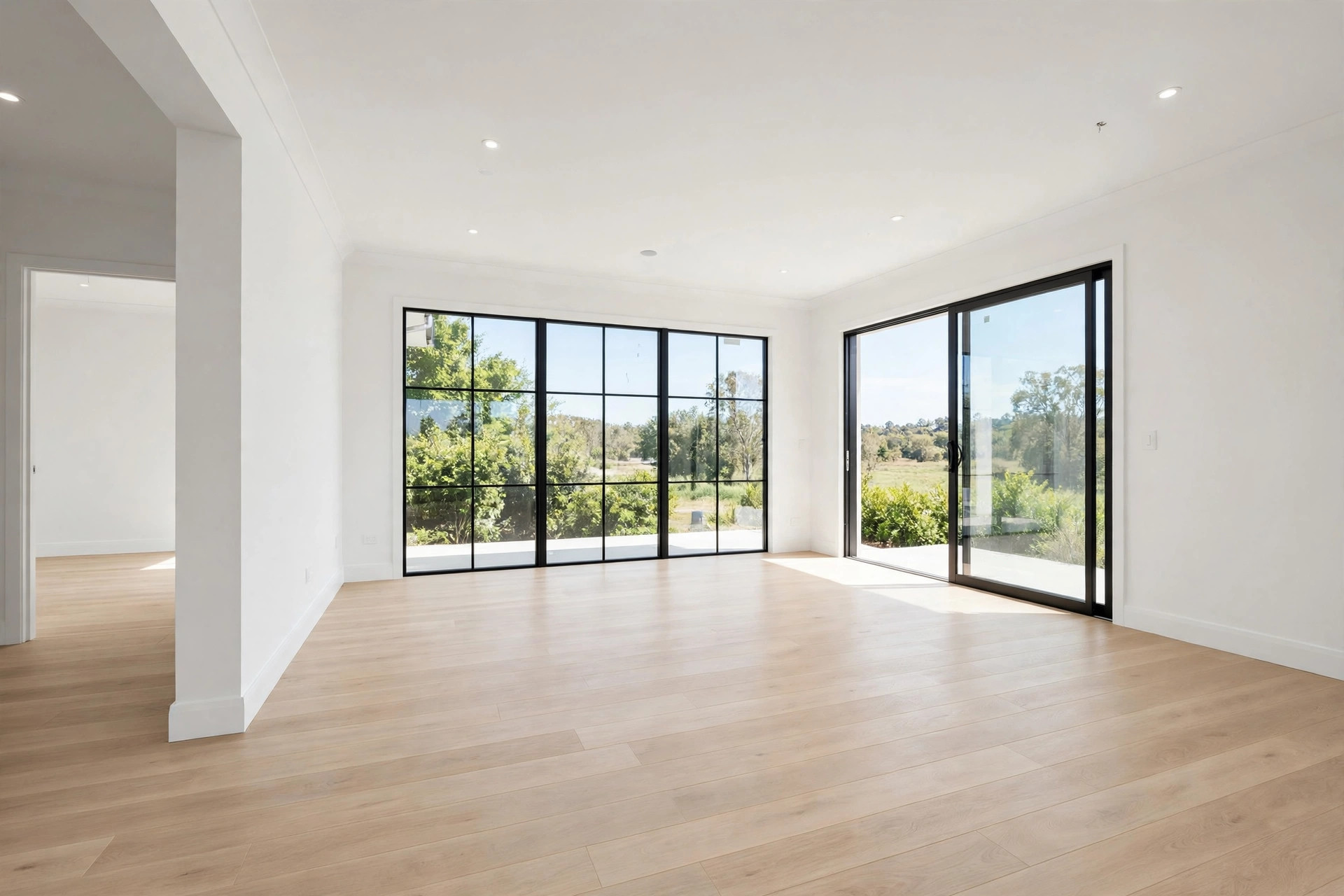
Doors, windows and interior. Representative doors and windows opened and closed, floors, walls, ceilings, stairs, railings, and garage doors and openers.
What to do before you close
Our advice, as editorial guidance rather than a prescription from any inspection standard, is to hire an independent inspector before closing, and to consider a second inspection before your warranty deadlines pass. Neither InterNACHI nor ASHI sets inspection timing.
Walk the finished home before closing and flag anything that needs attention. Read the written warranty before signing, file any claim in writing, and keep records. If you suspect structural movement, such as unlevel floors or out-of-square door frames, get a structural engineer, not only a general inspector.
An ASHI Certified Inspector must have completed at least 250 fee-paid inspections, passed the National Home Inspector Examination, and completed annual continuing education.
New-home sales eased in September (new-home sales), even as builders reported weak sentiment (homebuilder sentiment).
Frequently Asked Questions
Are Lennar homes proven to be defective?
No. Both cases are allegations in complaints, not findings. No court has found in these cases on the facts verified here.
What is the South Carolina case about?
The Thompsons allege the second floor of their Georgetown model house in Summerville sagged in 2023, and the complaint says the defendants blamed an improper I-joist. It is a proposed class action, not a certified class.
What does a general home inspection not do?
It is a non-invasive, visual examination of accessible areas on the date of inspection. It will not find concealed defects, determine code compliance or mold presence, or provide engineering services.
Sources: Conrad and Scherer, L.L.P., 29 September 2025; Thompson complaint, filed 14 March 2024; Lennar Corporation; Federal Trade Commission, July 2005; InterNACHI, October 2017; ASHI; New York Post, 4 November 2026 (reported statement only). Checked against the issuing organisations' own pages or court filings on 6 November 2026.