Freddie Mac: 30-Year Mortgage Rate Rises to 7.28%
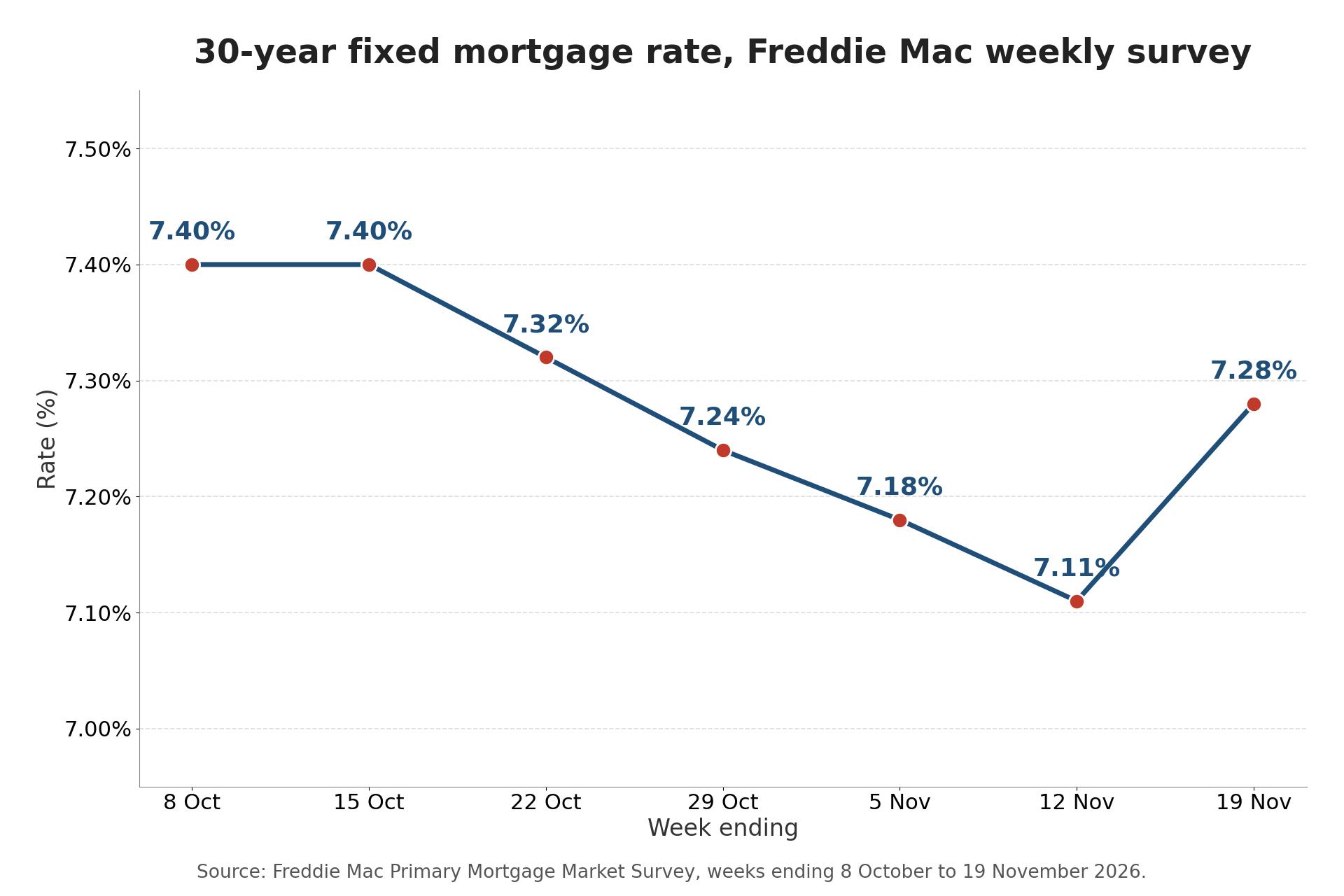
Freddie Mac mortgage rates turned back up this week. Freddie Mac's Primary Mortgage Market Survey, released Thursday 19 November 2026 under the title "Mortgage Rates Average 7.28%", put the average 30-year fixed rate at 7.28%, up 0.17 percentage points from 7.11% the week before. It is the first weekly rise since the survey week ending 8 October 2026, when the rate rose 0.12 points to 7.40%. The 15-year fixed rate rose further to 6.66%, up 0.21 percentage points from 6.45% the week before.
Freddie Mac mortgage rates: the numbers behind the rise
A year ago, in the survey week ending 20 November 2025, the 30-year fixed averaged 6.26% and the 15-year fixed averaged 5.54%, so the 30-year rate is now 1.02 percentage points higher than a year ago and the 15-year rate is 1.12 points higher.
After the 30-year rate reached 7.40% in the week ending 8 October, it held unchanged at 7.40% on 15 October, then fell for four straight weeks to 7.11% on 12 November. This week's 7.28% breaks that run. It is the highest reading in the four survey weeks after 22 October, when the average was 7.32%, though that reading was higher, so the rise is a reversal of the recent decline rather than a new peak. For the year so far, the 30-year fixed has ranged from 5.98% (week ending 26 February) to 7.40% (weeks ending 8 and 15 October).
What the rise costs on a $400,000 loan
On a $400,000 loan, principal and interest only, with no taxes, insurance or fees included, the 30-year fixed payment is $2,737 a month at 7.28%, against $2,691 a month at 7.11% last week, $46 a month more in a single week. A year ago, at 6.26%, the same loan cost $2,465 a month, so the same borrower now pays $272 a month more. The 15-year payment is $3,520 a month at 6.66%, against $3,473 a month at 6.45% last week, a rise of $47 a month, and $3,277 a month a year ago at 5.54%, $243 a month less than today. Those figures assume the survey rate for well-qualified borrowers with strong credit, so many real borrowers will pay more.

The daily rate is higher still
Mortgage News Daily's daily 30-year fixed index stood at 7.45% on Thursday 19 November 2026, down 0.01 points on the day, after 7.51%, 7.48% and 7.46% on 16, 17 and 18 November. A year earlier it was 6.36%, so it is 1.09 points higher year over year.
The gap is timing: the weekly survey averages rates offered from the prior Thursday through Wednesday, so it lags the market by days, while the daily index moves with each day's trading. The split is why mortgage rate headlines disagree, and it is why a borrower locking today will pay more than the 7.28% headline suggests. The weekly survey average and the daily rate are two different measures of the same market.
Why rates turned: a hotter October inflation report
The Consumer Price Index for All Urban Consumers increased 0.4 percent on a seasonally adjusted basis in October 2026, after rising 0.6 percent in September. Core CPI, the index for all items less food and energy, rose 0.3 percent in October, as it did in September and August, a third straight month at 0.3 percent. The shelter index rose 0.3 percent in October and accounted for over thirty percent of the monthly all-items increase.
Both prints beat consensus forecasts of 0.3 percent for headline CPI and 0.2 percent for core CPI. The Bureau of Labor Statistics published the release on Tuesday 10 November 2026, and the details are covered in the October CPI report. The Bureau published no 12-month percent changes for October 2026, having collected no survey data for October 2025 during the lapse in appropriations.
The Fed is leaning toward more hikes
Minutes of the Federal Reserve's 27-28 October meeting, released Wednesday 18 November 2026, show a committee moving toward further rate increases. The minutes state: "With regard to the outlook for monetary policy in the months ahead, almost all participants judged that, under their baseline outlooks for inflation and the labor market, further action to raise the target range for the federal funds rate, broadly consistent with the September Summary of Economic Projections, would likely be appropriate, in order to ensure a timely return of inflation to the 2 percent objective." The minutes add: "A couple of participants noted that an increase of more than 25 basis points could warrant consideration at the next meeting if incoming inflation data were unfavorable."
At the October meeting, the committee voted 10-2 to hold the federal funds target range at 3-3/4 to 4 percent, with Lisa D. Cook and Beth M. Hammack dissenting in favour of a 25 basis point increase at that meeting.
Governor Christopher Waller went further in public. In a televised CNBC interview on Wednesday 18 November 2026, as reported by multiple outlets, Waller said he was "very, very concerned" about inflation, that it was "headed in the wrong direction and spreading out", and that the Fed needs to be "a little more aggressive". He said the Fed should raise rates by 50 basis points in December unless it clearly signals another hike in January. Waller had set the test himself on 10 November: a 50 basis point hike should be considered if October core CPI came in at 0.3 percent or higher. It did, at exactly 0.3 percent.
The next Federal Open Market Committee meeting is 8-9 December 2026, with the decision announced Wednesday 9 December.
What the survey actually measures
The weekly survey figure is not a quote a borrower can lock. It is built from loan applications submitted to Freddie Mac through its automated underwriting system, Loan Product Advisor, covering conventional, conforming, first-lien purchase mortgages with a loan to value of 80 percent. Each weekly figure averages rates offered from the prior Thursday through Wednesday, describes well-qualified borrowers with strong credit, and is a note rate, not an APR, that excludes most points and fees. A borrower with a smaller down payment, a lower credit score, or a loan outside the conforming limits will see a different rate, usually higher. Read the survey as a direction signal rather than a price tag.
What to watch next
The next Freddie Mac survey is due Wednesday 25 November 2026, at 11 a.m. Central, a day earlier than usual because Thursday 26 November is Thanksgiving Day. It will show whether this week's rise was a one-week bounce or the start of a new climb. The bigger date is Wednesday 9 December, when the Federal Open Market Committee announces its decision. The window of falling rates that opened in late October has closed, and the cost of waiting has started to rise again.
Frequently Asked Questions
What is the average 30-year mortgage rate now?
Freddie Mac's survey put the 30-year fixed rate at 7.28% in the week ending 19 November 2026, up 0.17 percentage points from 7.11% the week before.
Is this the first time mortgage rates have risen in weeks?
Yes. It is the first weekly increase since the survey week ending 8 October 2026, when the rate rose 0.12 points to 7.40%. It then held unchanged once and fell four straight weeks, to 7.32%, 7.24%, 7.18% and 7.11%.
How much more does a $400,000 mortgage cost than a year ago?
On a $400,000 loan, principal and interest only, the 30-year payment is $2,737 a month at 7.28%, against $2,465 a month a year ago at 6.26%, which is $272 a month more. The 15-year payment is $3,520 a month at 6.66%, against $3,277 a month a year ago at 5.54%.
Why did mortgage rates rise this week?
Hotter than expected October inflation. Headline CPI rose 0.4 percent and core CPI rose 0.3 percent, above consensus forecasts of 0.3 percent and 0.2 percent. The Federal Reserve's October meeting minutes, released 18 November, also showed almost all participants expecting further rate hikes, and Governor Christopher Waller said in a CNBC interview the same day that the Fed should raise rates by 50 basis points in December unless it clearly signals a January hike.
What is the daily mortgage rate, and why is it higher than 7.28%?
Mortgage News Daily's daily 30-year fixed index stood at 7.45% on 19 November 2026, above the weekly survey average of 7.28%. The weekly survey averages rates offered from the prior Thursday through Wednesday, so it lags the market.
When is the next Freddie Mac mortgage rate survey?
The next survey is due Wednesday 25 November 2026, at 11 a.m. Central, a day earlier than usual because Thursday 26 November is Thanksgiving Day. The next Federal Open Market Committee decision follows on Wednesday 9 December 2026.
Sources: Freddie Mac, "Mortgage Rates Average 7.28%", Primary Mortgage Market Survey, released 19 November 2026; FRED MORTGAGE30US and MORTGAGE15US series; Mortgage News Daily 30-year fixed table; U.S. Bureau of Labor Statistics, Consumer Price Index, October 2026, USDL-26-1685, released 10 November 2026; Federal Reserve, Minutes of the Federal Open Market Committee, October 27-28, 2026, released 18 November 2026; CNBC interview with Federal Reserve Governor Christopher Waller, 18 November 2026, as reported by multiple outlets.