Junk Drawer Organization: A 30-Minute Reset
Every house has one: the drawer where dead batteries go to mingle with twist ties, mystery keys, and a single chopstick. It started as "the drawer for little things" and quietly became a graveyard of almost-useful stuff. Here's the good news, junk drawer organization is the single most satisfying declutter project you can finish before lunch. It takes about thirty minutes, costs basically nothing, and it gives you that tiny jolt of control that makes you want to tackle bigger messes.
In this guide, you'll learn a simple 30-minute method for dumping, sorting, and resetting your junk drawer; how to make budget and DIY dividers from things you already own; what actually deserves to live in a junk drawer (and what needs to go); and the one-in-one-out rule that keeps it from sliding back into chaos. Grab a trash bag and set a timer, let's go.
Junk Drawer Organization: The 30-Minute Dump-and-Sort Method
The whole reset happens in four quick stages. Give each one a chunk of your thirty minutes and resist the urge to overthink.
Minutes 1–3: Set up your stations
Pull the drawer out as far as it will go (or lift it out entirely if it allows) and dump every single thing onto the counter or table. Wipe the empty drawer out with a damp cloth while it's bare, crumbs and dried mystery goo have no place in your fresh start. Now make three stations on your counter:
- Keep, things that genuinely belong in this drawer and get used
- Toss, dried-up pens, broken clips, dead batteries, rubber bands that lost their snap
- Relocate, things that belong somewhere else in the house entirely
Minutes 4–15: The triage
Pick up every item and send it to a station. No "I'll deal with this later" pile, that fourth pile is how junk drawers happen in the first place. Be honest with yourself: when did you last use that key? If you can't name what it opens, it's a toss (or go do a five-minute key audit of the house and toss the strays). Batteries you're unsure about? Most stores that sell batteries recycle the dead ones, so make a little bag for a recycling run.
A fast filter that helps: if it's genuinely useful and homeless, keep it. If it's useful but has a home, relocate it. If it's not useful, toss it.
Minutes 16–22: Add dividers
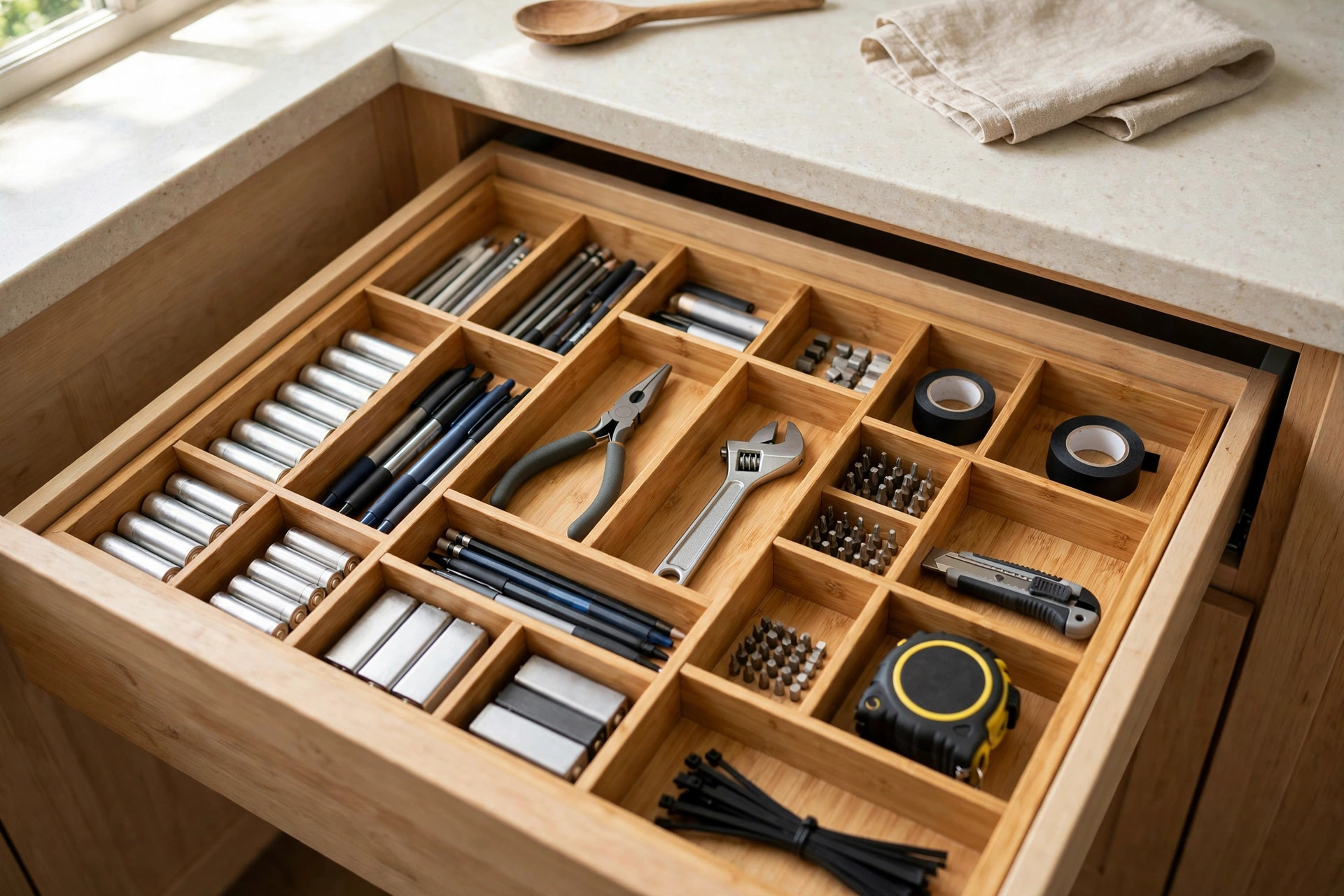
This is where the magic happens. A junk drawer without dividers is just a smaller junk drawer waiting to happen, everything slides together into one tangled layer. Sort your "keep" pile into loose groups first (tools, tape and fasteners, paperwork bits, tech odds and ends), then give each group its own zone.
Minutes 23–30: Load it back in
Place everything back into its zone, heaviest items at the back so the drawer doesn't feel tippy. Leave one small zone, roughly a fifth of the drawer, deliberately empty. That breathing room is your overflow buffer, and it's what makes the system survivable. Done. Admire your work. Open and close the drawer twice for the serotonin.
Budget Drawer Dividers That Actually Work
You don't need a custom bamboo insert to get an orderly drawer. Drawer dividers on a budget work just as well, the only job of a divider is to stop things from migrating.
DIY dividers from small boxes
Before you buy anything, raid your recycling and your cabinets:
- Tea boxes and small gift boxes make excellent compartments for paper clips, batteries, and thumbtacks. Cut the flaps down to drawer height with scissors.
- Muffin tins or silicone muffin cups are perfect for tiny hardware, screws, nails, picture hooks. Round cups keep small things from hiding in corners.
- A silverware tray you aren't using can drop straight into a wide drawer and instantly give you four or five zones.
- Cardboard strips slotted together in a grid (cut halfway through each strip so they interlock like a tic-tac-toe board) make a custom-fit divider for the cost of one cereal box.
If you do want to buy, spring-tension dividers and adjustable bamboo trays are inexpensive and survive many more declutter rounds than flimsy plastic. But honestly? Boxes you cut yourself often fit better because they're made for your drawer.
The two-minute divider test
Before committing to any layout, set your boxes or trays in the empty drawer and drop the items in loosely. Open and close the drawer firmly a few times. If things stay put, you've got a winner. If dividers slide around, add a strip of nonslip shelf liner under them or a dab of removable mounting putty at the corners.
What Deserves to Live in a Junk Drawer (and What Doesn't)
A junk drawer works best when it's really a utility drawer: the home of small, genuinely useful household things that don't have a better place. That distinction matters. Here's a practical split:
Belongs here:
- Scissors, a tape measure, and one multi-tool or screwdriver set
- Tape (one packing roll, one small roll), super glue, and a glue stick
- Batteries (a small, labeled stash), a flashlight
- A notepad and a couple of working pens
- Twist ties, binder clips, rubber bands, in reasonable quantities
- A lighter or matches, if you use them
Doesn't belong here:
- Tools with a real home, hammers and wrenches belong in the toolbox
- Mail, receipts, and coupons, that's a paper pile problem, not a drawer problem
- Expired coupons, dead pens, manuals for appliances you no longer own
- Anything you haven't touched in a year and can't name a use for
- Loose change that keeps multiplying, give it a jar or a bank instead
The guiding question is simple: is this small, useful, and homeless? Three yeses and it stays. Anything else is just visiting.
Keep It That Way: The One-In-One-Out Rule
The reset is the easy part; keeping it reset is the project. The rule that does it: one in, one out. Every time something new moves into the junk drawer, something old moves out. New flashlight arrives? The old one leaves. Fresh pack of batteries? The half-dead strays go to recycling.
Two more habits keep the re-clutter away:
- The 30-second return. When you borrow the scissors, put them back in their zone, not on the counter "for now." Most re-clutter is just deferred put-away.
- The quarterly five-minute skim. Once a season, dump the drawer onto the counter, toss what's died or dried out, and confirm everything still earns its spot. Five minutes, four times a year, and the drawer never becomes a project again.
Think of the junk drawer as your declutter training wheels. It's small enough to finish, satisfying enough to remember, and the habits it teaches, triage, zoning, one-in-one-out, scale up to closets, garages, and whole rooms.
Frequently Asked Questions
How often should I reorganize my junk drawer?
A full reset is usually a once-a-year job at most. In between, do a five-minute seasonal skim to toss dead batteries, dried-out pens, and anything that wandered in. If the drawer is overflowing, that's your sign the one-in-one-out rule slipped.
What's the best way to organize a deep junk drawer?
For deep drawers, think in layers: a shallow tray or small boxes on top for daily-use items (pens, tape, clips), and the drawer floor below for bulkier things (flashlight, tape measure). Avoid stacking small loose items, they'll vanish into the depths.
Should I buy drawer organizers or make my own?
Either works. DIY dividers from small boxes and muffin cups are free and fit your exact drawer, so they're a great starting point. Buy organizers when you want durability, adjustable bamboo or spring-tension dividers last for years and look tidier.
How do I stop my junk drawer from getting messy again?
Two habits: the one-in-one-out rule (something leaves every time something new enters) and the 30-second return (put borrowed items back in their zone immediately). Most junk drawers refill because of deferred put-away, not because of bad intentions.
What should I do with all the stuff I pulled out?
Sort the overflow into three fates: relocate items to their real homes (tools to the toolbox, mail to the desk), toss or recycle what's broken or dead (old batteries go to a battery recycling drop-off), and donate anything usable you simply don't need. Don't bag the "relocate" pile and set it aside, walk it to its homes now, or it becomes a new junk pile.